There's an international standard when it comes to "perfect" toast. Here's how the magic happens, plus some recommended toasters to help you get your ideal slice.
What is "ideal" toast?
When British food consultant Dom Lane was tasked with devising a formula for “perfect” toast, he toasted (and tasted) 2000 slices over the course of a week.
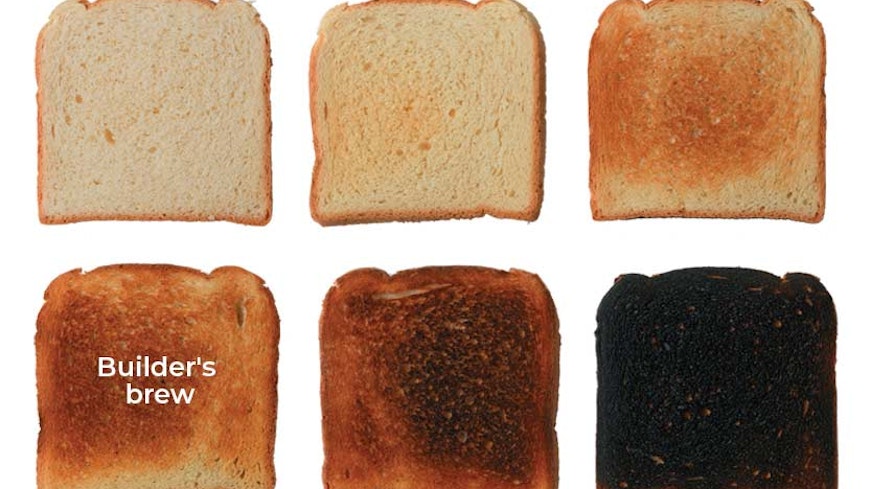
According to food consultant Dom Lane, toast is perfectly done when its colour matches that of a cup of strong tea (
He determined that the ideal ratio of outside crunchiness to inner softness was 12:1. He achieved that “golden mean” by toasting a 14mm-thick slice of seeded loaf (taken straight from the fridge) for 216 seconds, with a 900W toaster’s brownness dial set to five out of six for an optimum element temperature of 154°C.
The result? Dr Lane's conclusion was that toast is perfectly done when its colour matches that of a cup of strong tea or looks like "builder's brew".
Tip – now that you know how to make perfect toast, Dr Lane has a final word of advice: to prevent toast from turning soggy, he recommends you first warm the plate to 45°C, as that minimises condensation.
The science behind turning bread into toast
When things heat up, the Maillard reaction kicks in, enabling certain sugars and proteins in the bread to bond. New molecules are formed, and they in turn join forces, creating increasingly complex compounds. It’s this interplay that creates the mouth-watering aroma and golden goodness we associate with toast.
But high moisture content puts a damper on the process – the Maillard reaction is slow to occur below 100°C, and the water prevents the temperature from rising above this. (That's why we also test toasters using a moister seed bread such as Bürgen).
Top toasters
After testing 61 toasters to assess their cooking performance and how easy they are to use, we recommend nine of them. We tested toasters by cooking:
fresh white bread over four runs in quick succession to check for browning evenness and consistency
a single slice
bread straight from the freezer
two slices of Bürgen Soy-Linseed bread, as the setting that produces a well-toasted slice using white bread might not be hot enough to deliver crunchy Bürgen.
Here's a model we recommend that should make your bread-to-breakfast routine a breeze.
For more on buying the right toaster, see our buying guide.
To find out which other toasters we recommend, check out our full test results.

We can't do this without you.
Consumer NZ is independent and not-for-profit. To help us get a fairer deal for all New Zealand consumers, you can make a donation. We’ll use your contribution to investigate consumer issues and work for positive change.