By Nick Gelling
Product Test Journalist | Kaipūrongo Whakamātautau Hautaonga
This article appeared in the spring 2026 issue of Consumer magazine.
A global shortage of computer memory has quickly driven up the price of technology for consumers. Next time you need a new device, you’ll face a dilemma – spend a lot more money or settle for a downgrade.
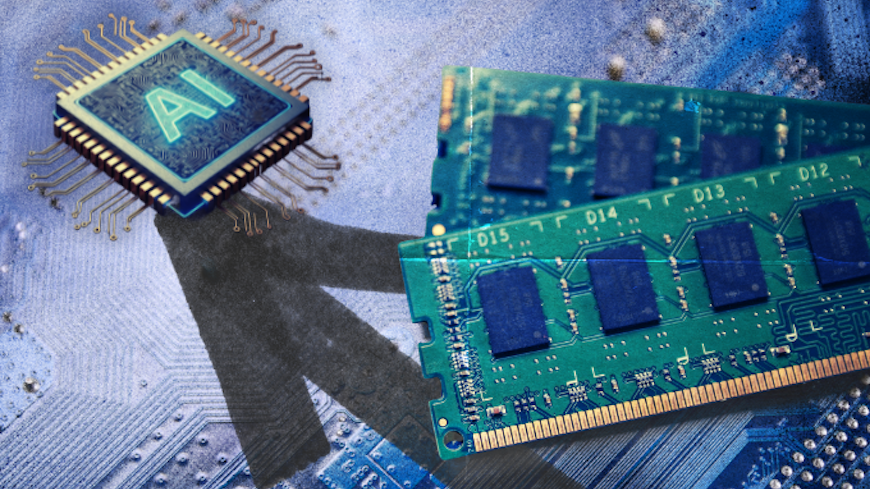
Several computer components have exploded in price this year. Most notably, random-access memory (RAM) – the short-term storage a computer uses to do calculations and run programs – now costs three times what it did in 2025.
RAM, which is made up of billions of tiny electronic circuits housed on silicon microchips, is crucial for making tech run quickly but is swiftly becoming a pricey luxury. The current shortage is making it an extremely difficult time to build a new desktop PC, or upgrade an old one, and is affecting both computer enthusiasts and major manufacturers.
Companies building laptops, phones and tablets – and even other computerised devices like TVs – are now paying significantly more for the parts they use. And, unfortunately, they’re passing on those costs to consumers. For example, Dell’s latest XPS 14 laptop saw a price rise in May, only 4 months after it launched. The version with 32GB of RAM now costs an extra $600 – a 15% increase.
Not even the second largest company in the world, Apple, is immune. In June, chief executive Tim Cook told the Wall Street Journal that Apple had “been trying to shield our customers from the increases, but the situation has become unsustainable”. A week later, the price of the cheapest MacBook Air increased from $2,199 to $2,599 and the MacBook Pro rose from $3,299 to $3,899.

Need a new laptop?
We’ve reviewed more than 20 current models, including five that cost under $2,000. Find out how they did in our tests.
It isn’t only RAM that’s the issue, either. Flash storage, another kind of microchip that powers the solid-state drive (also known as an SSD) where you store all the files on your computer or mobile device, has also seen a surge in price.
A 2TB solid-state drive that cost $300 in September 2025 is now selling for more than $1,200. Central processing units (CPUs), the primary brain of a computer system, are also seeing significant price rises. Together, shortages of these key parts are spiking the prices of the computers they combine to form.
Why have all these components skyrocketed in price at the same time? Because supply can’t keep up with the massive increase in demand caused by artificial intelligence (AI).
AI data centres are to blame
Data centres are factory-sized collections of thousands of computers, used for storing files and running calculations over the internet. We have about 60 in New Zealand, with more under construction, including a humongous $3.5 billion centre in Southland being developed by Datagrid NZ.
Artificial intelligence companies, like OpenAI (ChatGPT) and Anthropic (Claude), require data centres in order to provide their services. Anticipating increased demand for their services in the future, they’re building data centres at breakneck speed, as are third parties like Datagrid NZ, which bank on being able to rent their centres to the highest bidder. According to media reports, companies are filling these new centres by buying up almost all the RAM being produced globally, as well as significant proportions of the world’s flash storage and CPUs. Unfortunately, that includes the supplies that would normally go into consumer devices.
AI companies can afford to outbid everyone else for tech because of the immense investment they’ve received over the past couple of years. An estimated 45% of the S&P 500, an index of 500 of the largest companies on the US stock market, is made up of AI-linked companies. The US market is now far more concentrated on tech than it was during the dot-com bubble in the late 1990s.
The computer component manufacturing industry is trying to ramp up production to meet demand, but it takes time to build the factories required. Supply will eventually catch up, or the AI stock bubble will burst and reduce demand. But all three of the major RAM producers in the world – Samsung, Micron and SK Hynix – say pressure won’t ease until 2028. Samsung speculates that the shortage will be worse in 2027 than it is now, while SK Hynix predicts the supply chain crunch could continue in some form until at least 2030.

The best cheap smartphones
Don’t pay more for features you won’t use. We’ve picked our favourite models under $500 and under $1,000.
Any product with a computer in it will be affected, in some way, by RAMageddon (a term coined by tech publication Tom’s Guide to describe the current worldwide RAM shortage, and one I really wish I’d thought of myself).
But it isn’t only the demands of our new AI-generated world that are contributing to increased prices on consumer products. Other factors include increased shipping costs and disrupted supply chains stemming from US attacks on Iran, and ongoing trade tariffs to and from the US.
The effect of RAMageddon on gaming hardware
Gaming hardware is one of the sectors affected most critically by RAMageddon. Memory and storage are two fundamental functions of a game console, and they can’t be skimped on. Recent generations of game consoles have already been sold at paper-thin margins – sometimes even at a loss – so manufacturers can’t afford to absorb the increased costs of parts, tariffs and transport. That means higher prices for gamers. For example:
Nintendo’s Switch 2 console had its price jacked up from $800 to $970 on 1 September – an increase of 21% – barely a year after its launch.
All three versions of the PlayStation 5 saw a price rise in April 2026, with manufacturer Sony citing “continued pressures in the global economic landscape”. Reportedly, Sony is considering delaying the release of the PlayStation 6 in the hopes that prices come down.
Xbox is also rethinking its next console, slated for 2027. “We need to change as a company to make sure it is affordable,” said an Xbox executive in June, after labelling the current RAM price a “crisis”. In a cruel twist, Xbox’s parent company, Microsoft, is one of the main companies fuelling the crisis. Microsoft is OpenAI’s largest investor and has spent at least $100 billion on AI to date.

Why are newer laptops less powerful?
Technology is about gradual progress. Typically, memory, storage and computing speed get cheaper each year, translating to cheaper devices, improved specifications or both.
However, faced with ballooning costs, some manufacturers have chosen to instead lower the specifications of their 2026 models, so as to maintain affordable sticker prices.
That means, in a deviation from the history of computers, the next device you buy might be less powerful and have less storage than your current one.
For example, Apple announced its newest MacBook in March. The MacBook Neo has a maximum of 8GB of RAM – half as much as any other MacBook since 2018. It also uses the processor from the 2024 iPhone 16 Pro, rather than the type of processor found in every other Mac and in premium iPads. At launch, it was the cheapest MacBook ever, but it’s already had its price hiked to begin at $1,399.
You can read my review of the Neo and see how it performed in our tests.
Keep your devices working for longer
More than ever, now is the time to make a real effort to take care of those devices that are a few years old but still work fine. You might be able to extend the lifespan of a phone, laptop or tablet by replacing its battery, deleting old files and apps you don’t need anymore and keeping it from overheating. If you can keep your device operational until at least 2028, you should be able to wait out this strange episode of tech history. If you’re lucky, you’ll come out the other side able to buy a better product than you could afford during RAMageddon.
Want more independent advice to help you shop smarter? Subscribe to the Consumer NZ newsletter and get our best stories in your inbox every week.