By Rebecca Styles
Research Lead | Hautū Rangahau
If you can’t live in your home after a disaster, most comprehensive house insurance policies provide some money to pay for temporary accommodation.
Yet, in some cases, the money runs out before claims are settled or homes are liveable again. We look at the temporary accommodation entitlements in selected house insurance policies and ask whether they need to be increased.
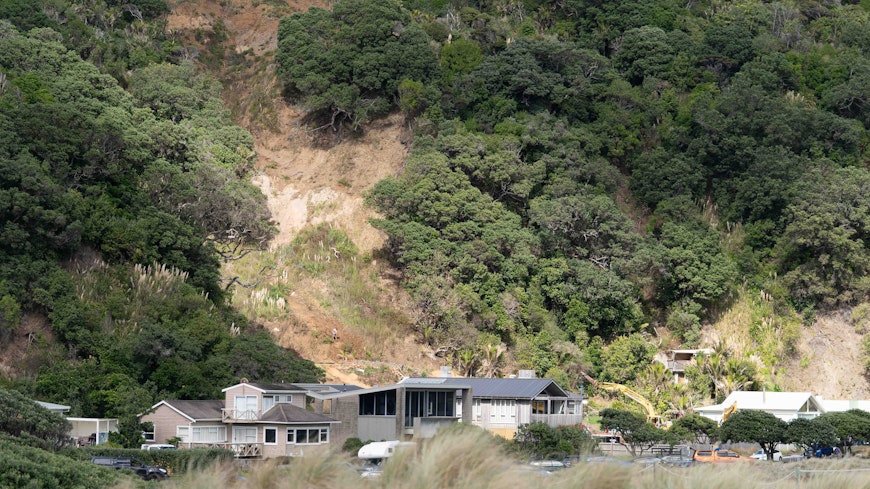
The landslide started on a neighbouring property, and “it just came through and missed our house by a few metres,” said Tasha. I spoke to Tasha about her experience with house insurance after Cyclone Gabrielle ripped through Piha in February 2023.
In the immediate aftermath of the storm, it wasn’t safe for Tasha to stay in her home because the land was unstable, so she had to find alternative accommodation.
“Initially, I stayed in people’s little huts. A friend had an empty bach that I stayed in for a month because, at that point, we didn’t even really know what would happen with the house. About 2 months down the track – maybe 6 weeks after the event – I rented somewhere temporary in Piha.”
Tasha was entitled to a temporary accommodation benefit as part of her house insurance.
“It’s a really important part of insurance. That was a lovely surprise, because I just never considered that I could have accommodation paid for. I was quite ignorant of what could happen after a big event, so I was really very grateful for the temporary accommodation payment.”
However, Tasha’s accommodation benefit only lasted a year.
“Often natural disasters take a lot longer than a year to remedy […] it’s unrealistic to have repairs done within a year. So, after a year, it’s a real challenge. You’re left with having to fund possibly a mortgage as well as your rent.”
While a straightforward land claim can take 3 months to process, a review of the National Hazards Commission (NHC) scheme after the 2023 extreme weather events found that complex cases, particularly those involving a land claim, can take far longer.
Tasha’s claim took 18 months to settle. Eventually, the council bought her out, and she moved away from Piha.

What is the accommodation benefit?
Most comprehensive house insurance policies include a temporary accommodation benefit for situations where your home is no longer habitable after an event, such as an earthquake or house fire.
Crucially, this means, if you have been paying a mortgage on your home, you can continue to pay that mortgage out of your existing budget, with the money from the insurance’s benefit being used up on paying rent elsewhere while your home is being repaired.
Temporary accommodation benefits in comprehensive house insurance policies
Of the house insurance policies we monitor, the benefit ranges from $20,000 through to $50,000.
With AA Insurance, the amount of the benefit varies depending on the circumstances of the damage. While the basic benefit is $20,000, if the damage happened as the result of an earthquake or a tsunami, the insurer might decide to increase the benefit to $40,000.
It might also extend the time period in which you must use the benefit.
Some insurance companies require the benefit to be used within 12 months, while others don’t stipulate any deadline. However, the amount available is always capped, so, once the money is spent, there’s no more available.
The benefit also provides some cover to enable you to put your cat and dog in temporary accommodation and, in the case of FMG, a contribution towards certain vet fees. There is also some allowance for storage if you need to remove contents from your damaged home, but, all these benefits are generally deducted from the total temporary accommodation benefit.
However, as Tasha found out, if your house is severely damaged, or you’re waiting to hear whether your house will be bought out by the local council after a natural disaster, it’s likely you’ll need to find alternative accommodation for longer than 12 months. And, while $20,000 to $50,000 to spend on accommodation may sound a generous amount, it may well not cover a year or more of renting.
In Auckland central, the median cost for a three-bedroom house annually would be $23,400 based on figures from the government agency Tenancy Services. The most expensive city for rental accommodation is Wellington at $39,000.
Christchurch central would cost $29,120, while Dunedin comes in at $33,800.
To find out the median rental cost for where you live to see if your house insurance will give you enough cover, you can check out the database of current market rental prices from the Market rent webpage on the Tenancy Services website.
Temporary accommodation for renters
Renters who have contents insurance will likely have a provision in their policy for temporary accommodation. With some insurers, this is a lump sum, while others pay the difference in cost between the current and new temporary rent for a period.
Temporary accommodation benefit in renters’ comprehensive contents insurance policies
AMI, State and FMG have a temporary accommodation benefit of up to $30,000, while Tower and Trade Me provide the difference between your old rent and the cost of your new accommodation for up to 8 weeks.
With AMP, it’s slightly different again. AMP covers temporary accommodation up to 10% of your sum insured. So, if you’re insured for $35,000, you’ll be eligible for $3,500.
Included in the coverage is some allowance to put pets in temporary accommodation, even certain vet fees for cats and dogs with FMG.
There is also some allowance for storage if you need to remove contents from your damaged accommodation. However, this is generally deducted from the total temporary accommodation benefit.
Where else can you get accommodation support?
If you don’t have insurance that covers temporary accommodation after a natural disaster, you might be able to get help from the Temporary Accommodation Service.
This government service is activated in the event of a significant civil defence emergency to help people displaced from their homes for longer than 2 weeks.
Work and Income also offers emergency accommodation support for people who don’t have anywhere to stay and can’t afford short-term accommodation.
Should the accommodation benefit be increased?
There have been calls for the accommodation benefit to be increased to make up for any shortfall while people are waiting for their homes to be rebuilt or repaired.
The New Zealand Claims Resolution Service is a free government service that helps people with their insurance claims after a natural disaster. It’s come across cases where the benefit isn’t enough.
As a spokesperson told us, the service “continues to advocate for improved temporary accommodation insurance cover and flexible settlement practices. This is because we have found some homeowners are left out of pocket, as the temporary accommodation benefit is insufficient to cover insurance claims that take longer than expected to resolve.”
From Consumer NZ’s insurance premium survey, we can see that the benefit hasn’t increased in the past 5 years for AA Insurance, FMG, MAS or Trade Me, while for AMI and State Insurance, it’s gone up $10,000, and for Tower, it’s increased $5,000.
After the North Island extreme weather events in 2023, the government stepped in to support households to pay for additional accommodation while insured consumers were paying two lots of accommodation (mortgage plus rent). This payment kicked in once the insurance money ran out.
While $10 million was allocated to the fund, just under $5 million was spent. This involved pay outs to 165 eligible households, as well as some set-up costs. The scheme closed at the end of June 2025.
Even though the government made up the shortfall, the event highlights that, for some households, the accommodation benefit isn’t enough.
It’s also important to note that there’s no hard deadline for insurance companies to settle claims, so if claims are complex, or if a homeowner is in dispute with their insurer, there’s more financial pressure on that homeowner to settle if the accommodation benefit has run out.
We asked the Insurance Council of New Zealand (ICNZ) whether the accommodation benefit should be reviewed to see if it’s still working for policyholders.
An ICNZ spokesperson told us that insurers regularly review the provisions of their policies, such as the temporary accommodation benefit. They also suggested that any increase in the provision would likely mean an increase in the cost of the insurance policy.
Temporary accommodation provisions “aim to strike a balance between meeting the needs of customers and keeping premiums affordable,” they said.