By Chris Schulz
Investigative Journalist | Kaipūrongo Whakatewhatewha
Patricia* can always tell when her fly spray dispenser needs to be changed. "We've got a mid-century house, so it attracts a lot of spiders, flies and mosquitos," she says.
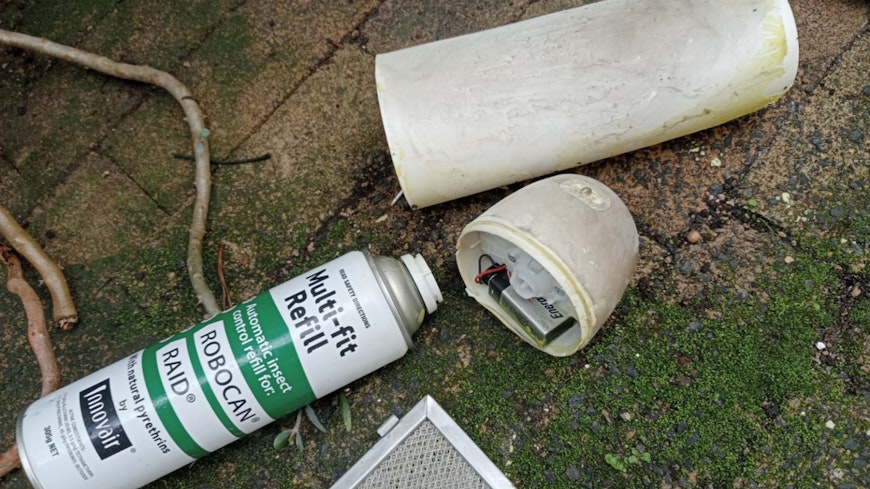
The dispenser sits in Patricia’s kitchen on a top shelf, dispersing regular squirts of fly spray, but when it runs out, “suddenly, there are little flying things all over the place”.
When this happened again in April, Patricia did what she always does and purchased a replacement Robocan multi-fit refill. The can contained fly spray made of “natural pyrethrins”.
“We've used it many times before,” she says.
Patricia had trouble fitting the can into the dispenser, so she gave it to her husband to sort out, which he did. “It did its usual test spray, and that was all OK,” she says.
She placed it back on a shelf in the kitchen, above the stove, where it had sat for years.
A few hours later, she was upstairs when she heard screams coming from the kitchen. “I could hear my husband and my eldest daughter yelling at one another,” she says.
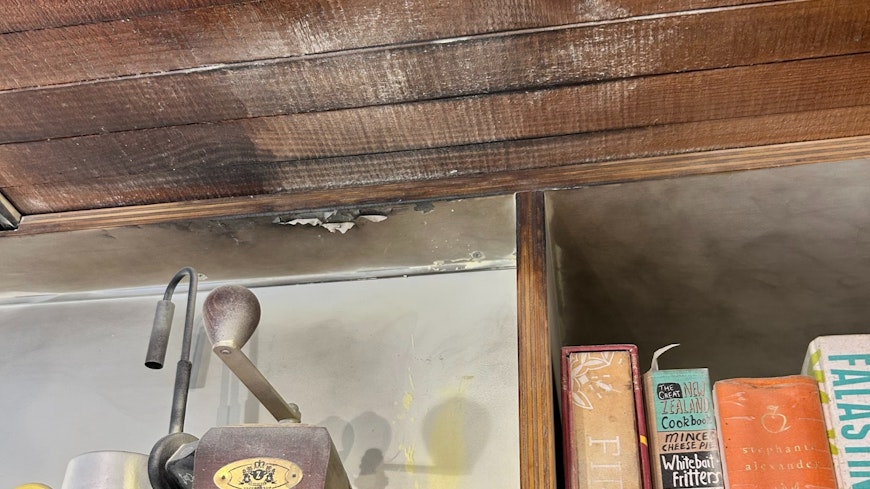
She ran downstairs and instantly saw smoke and flames. “The whole ceiling of the kitchen had caught alight.”
How did this happen?
The flames quickly spread up the kitchen wall, across the ceiling and onto a bookshelf containing the family’s cook books. “It's a wooden ceiling, rough sawn timber,” says Patricia. “Everything was on fire.”
Her husband grabbed a nearby fire extinguisher and immediately put out the flames. Patricia says the fire was out so quickly they didn’t need to call for help from the emergency services.
Then, they began cleaning up – and trying to work out what had happened.
Patricia’s daughter says she was preparing to cook something when the fire began, although she hadn't yet turned the gas stove on.
But the family reported hearing a ‘whoosh’ sound, which they believe came from their fly spray dispenser.
The dispenser was distorted and singed, so they threw it outside. Patricia believes the new can she’d just purchased had started leaking, that liquid had ignited, “and it just exploded”.
Should fly spray be used near kitchens appliances?
Consumer NZ attempted twice to contact SC Johnson, the company that owns Innovair, which produced Patricia’s fly spray refill can – but we received no reply.
Instead, we visited a hardware store to survey the fly spray dispenser refills. The range that fits Patricia’s dispenser, and which she’d purchased, contains a clear warning on the side of the can: “Flammable: do not store or use near fire or flame.”
It also says the product should be used in a “ventilated area” and that it should be “handled, stored and used as you would any aerosol product”.
Other fly spray products checked by Consumer all contain similar warnings. One suggested keeping it away from “sources of ignition”. But none outright suggested keeping them away from kitchens or kitchen appliances.
On its website, the Environment Protection Authority offers extra precautions, but these are to do with the contents of the can – not their potential flammability.
“Keep children and pets away from areas where insecticides are being used. Never eat or drink when applying the insecticide,” it warns.
Is this something that happens regularly?
A Fire and Emergency New Zealand spokesperson said they had no recent records of fly spray dispensers causing house fires.
But they did recommend handling flammable aerosols safely, and suggested the kitchen was the wrong place for them to live.
“Many aerosols contain gases and liquids that may be flammable near a fire or other ignition source, such as a gas stove top,” the spokesperson said.
“Fire and Emergency New Zealand recommends keeping flammable items well away from cooking areas.”
Patricia’s warning: ‘It’s a little bomb’
Patricia says that’s advice she’ll be taking from now on. She won’t use a fly spray dispenser at home again, and says she’ll be removing another one from the family’s holiday home too. “It’s a little bomb that we had in our kitchen,” she says.
She and her husband were about to head overseas when the fire began, and she can’t help but wonder what might have happened had it started at night, or while they were away.
“If it had been a week later, that could have been the end of our house,” she says. “It went up so quickly. It would have been a disaster.”
She wants to warn others to think about whether they need one in their home, and if they do, where they place it.
“Now that it's happened, it makes sense that you probably wouldn't want it in your kitchen,” she says. “But it never, never would have occurred to us.”
*Not her real name.
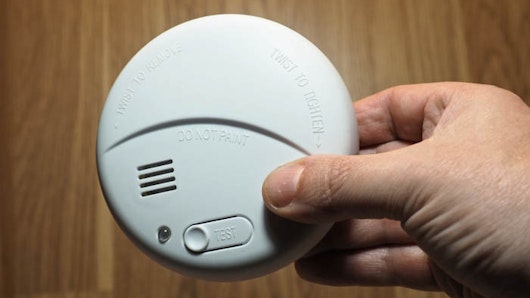
It's important to have a working smoke alarm
Have a look at our smoke alarms buying guide to make sure you have the right one for your home.