By Bryan Wall
Product Test Journalist | Kaipūrongo Whakamātautau Hautaonga
A heated drying rack sounds like it could be the answer to all winter laundry drying problems. We put The Warehouse’s Living & Co Heated Drying Rack to the test. Is it really a “practical and efficient way to dry your laundry” and worth the $70 price tag?
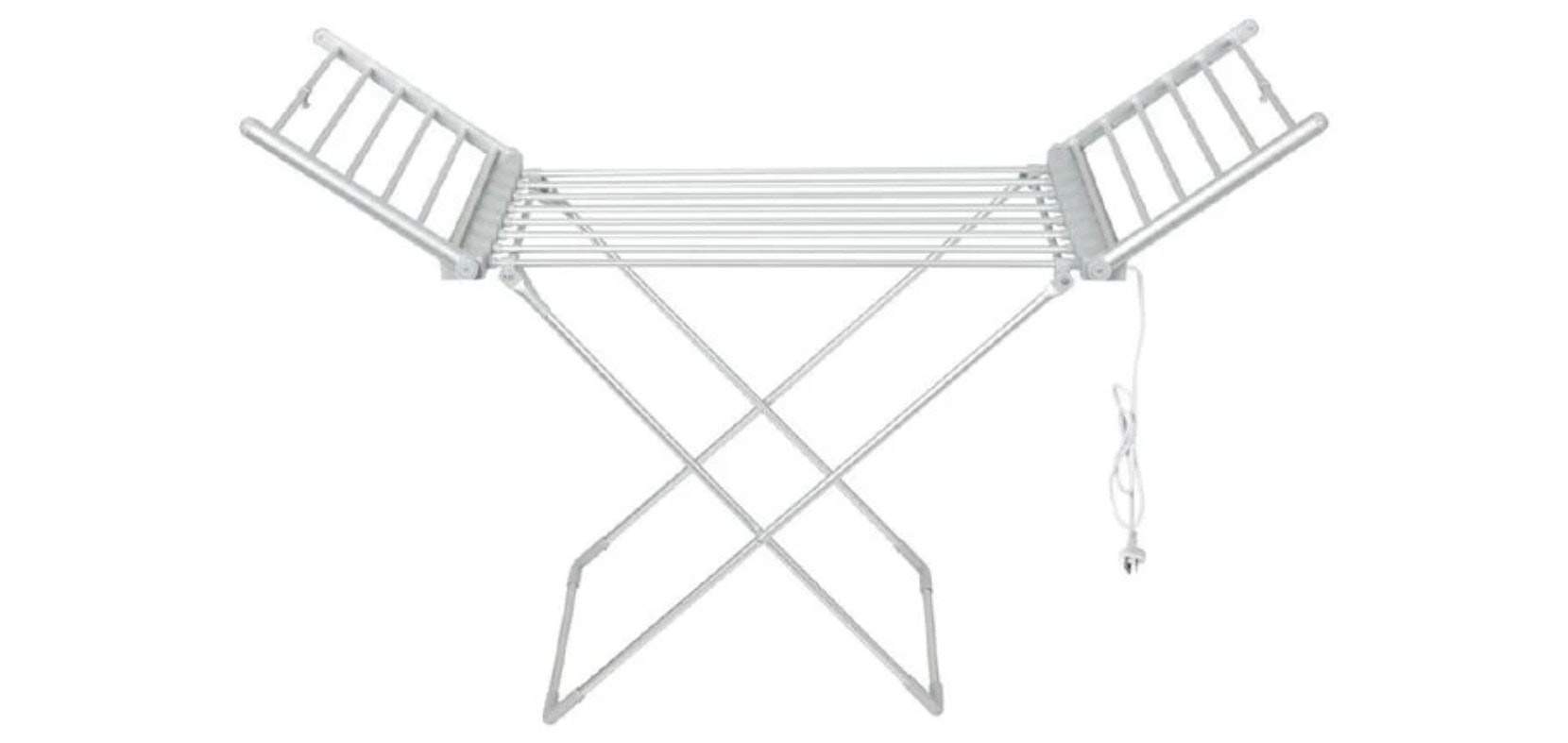
Heated drying racks
Heated drying racks resemble their non-electrified siblings but have much thicker aluminium bars. The heating coil runs inside these bars. The Living & Co heated drying rack folds flat for storage and has 2 fold-out wings for extra capacity. A single illuminated swich on the end rail turns on the 230W heating element.
The Living & Co model is actually lighter than a standard powder-coated steel drying rack from Briscoes at only 2.8kg compared with 3kg.
Heated drying rack pros and cons
Cheap to run, at around 6c an hour
Warms up quickly
Good for drying single large items or multiple small items laid flat as has many bars that are close together
Lightweight
Only dries fabrics that are in direct contact with the bars – does not radiate heat
Not effective if you hang washing vertically, like on a normal rack
Low drying capacity if laying clothes flat
How effective is a heated drying rack?
In our tests, we found the heated drying rack is really only effective for items that are laid completely flat and touching the heated rails in multiple places. If you hang a full load of washing vertically over the rails, you’ll be sorely disappointed. The results won’t be much better than using a standard clothes rack.
If your house is warm in winter, don’t waste your money. For colder homes, there might be some benefit though.
Laying clothes flat will reduce the rack’s capacity to 1 bath towel, or 2–3 T-shirts. Folding items in half could increase capacity, but the rack is probably best suited for drying socks and undies as you can lay out a decent number of those due to the number of bars and their close spacing.
How can I dry my clothes in the winter?
Read our tips for drying clothes over winter time.
If budget and space allow, consider buying a clothes dryer instead. Prices start from around $350.
Our test reviews can help you make the right choice.
Don’t be fooled into thinking that running a dryer will be vastly more expensive than the heated clothes rack. We tested drying a load in a dryer, and it used 1.9kWh of electricity and only took 1 hour – a cost of around 50c. To fully dry a load of clothes on the heated drying rack took 14 hours (in a 15°C room) – using 3.2kWh of electricity and costing around 80c. Impractical and inefficient in my books.
Alternatively, a dehumidifier combined with a standard clothes rack can be quite effective, too. This has the added benefit of removing excess moisture from your home. If this option interests you, then check out our dehumidifier reviews.
Our tests
We ran a few real-world tests using a couple of towels and 2 T-shirts, with the same load drying on a standard drying rack for comparison. We tried:
drying towels in a 21°C room
drying towels in a 15°C room
drying T-shirts in a 15°C room.
Drying towels in a 21°C room
We set up the drying racks side by side in the warm Consumer NZ office. We took two identical towels, with a dry weight of around 600g each, washed them, spun them at 1200rpm and then weighed them damp. Then we draped each towel flat over one of the racks. We did this to maximise contact with the heated rails. Every hour, we weighed the towels to see which was drying faster.
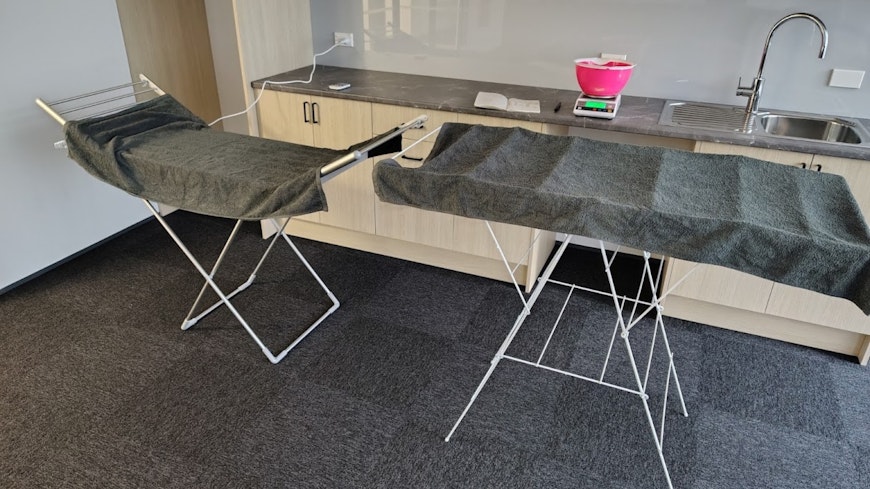
The graph shows that the towel on the heated drying rack had slightly more moisture in it at the start of the test, but the extra heat accelerated its drying, so it was pretty much dry 5 hours later at around 2pm.
In comparison, the towel on the non-heated drying rack took just 1 hour longer to dry.
Note: On the heated drying rack, the parts of the towel hanging over the edge and not in contact with the heated bars took longer to dry than the parts touching the bars.
Drying towels in a 15°C room
We repeated the test in a colder room to better represent a typical New Zealand home’s room temperature in the winter – think a student flat or a living room in the daytime without the heating on.
The towel on the heated drying rack clearly dried quicker and was nearly completely dry by 4pm.
The graph shows quite a gap between the two lines. This shows that the heated drying rack made more of a difference in the lower-temperature room – the towel on the non-heated drying rack was not fully dry until 7 hours later, around 11pm.
However, the graph doesn’t tell the whole story. As in the first test, even once the central section of the towel on the heated drying rack was fully dry, the edges that weren’t in contact with the heated rails were still quite damp.
Drying T-shirts in a 15°C room
Our final test involved hanging a T-shirt vertically on each rack, as you would if you were trying to get a full load of washing onto a rack.
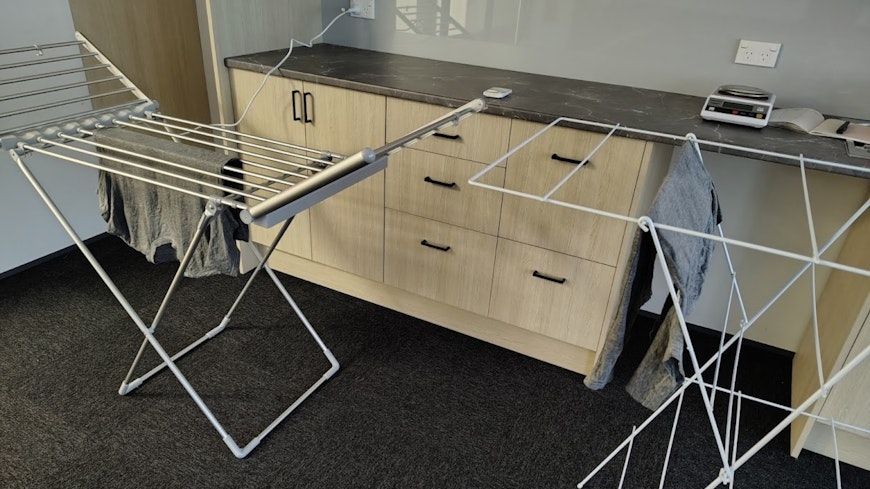
The T-shirt on the heated drying rack had about 15g more moisture in it at the start than the T-shirt we draped over the standard drying rack. After 2 hours, this extra moisture had been removed, and both T-shirts continued to dry at the same rate.
As expected, only the section of T-shirt that was touching the heated bars dried any quicker, giving us a lovely stripe effect a couple of hours into the test!
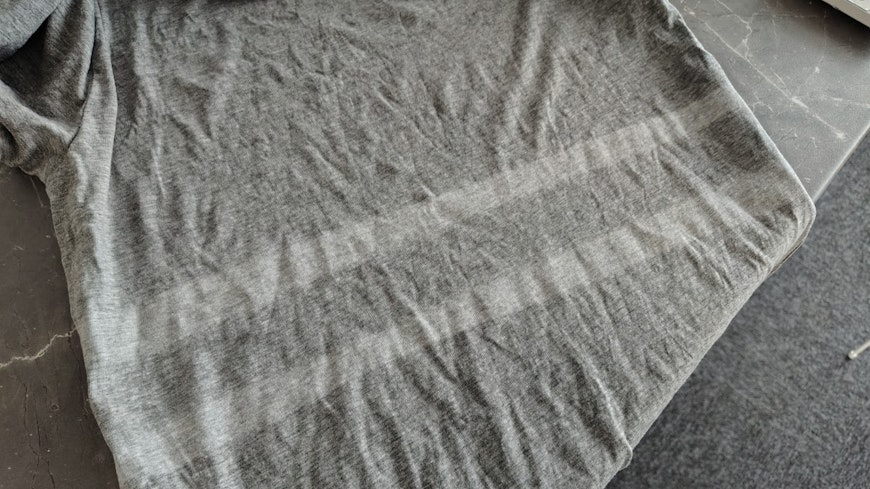
Both T-shirts dried fully at the same time later that evening.