By Paul Fuge
Powerswitch Manager | Pou Whakahaere Powerswitch
We see it all the time in our comments section – people arguing that nuclear generation could provide New Zealand with cheap, abundant electricity. Should we go nuclear?
No, we shouldn’t – for the simple reason that nuclear generation is far more expensive than the other options we are lucky to have available.
How much would nuclear power cost?
Transpower – which runs the national grid and operates New Zealand’s power system – recently looked at the likely costs of building new electricity generation as part of its Te Kanapu initiative, which is developing a blueprint for New Zealand’s electricity grid to be published next year. Its analysis found that nuclear power would be significantly more expensive than other options.
Recent estimates put the cost of nuclear generation at around $25,600 per kilowatt of capacity to build. This estimate excludes any wider industry investment required to support nuclear technology in New Zealand. By comparison, wind generation typically costs between $3,100 and $3,700 per kilowatt depending on the site, while large-scale solar costs range from $1,700 to $2,100 per kilowatt. These technologies are also familiar to New Zealand, with established industries, experienced workforces and a proven track record of deployment.
The costs of installing nuclear generation are expected to fall over time, but wind and solar costs are also expected to continue falling, meaning the gap is likely to remain substantial.
Other arguments against nuclear power
Beyond the cost, there are several other significant barriers to nuclear power in New Zealand. These include:
Earthquake risks: Although modern reactors can be designed to withstand earthquakes, New Zealand’s location on a major tectonic boundary could make it harder to gain public support for nuclear generation.
Damage to our brand: Our economy relies heavily on agriculture and a “clean, green” reputation. Even a perceived nuclear risk could affect New Zealand’s international brand and confidence in our food exports.
Lack of an existing nuclear industry: New Zealand lacks the regulatory framework, specialist workforce, fuel supply chain and infrastructure we need to build and operate nuclear power stations.
New Zealand already has established engineering capability and expertise in developing and operating renewable generation. From both a practical and an economic perspective, it makes more sense to build on those existing strengths than to start from scratch with an entirely new industry.
It’s a bit like asking why our sheep and beef farmers don’t also farm reindeer or water buffalo. In theory, they could. But they don’t know anything about farming reindeer and water buffalo. Getting this established would require new expertise, new regulations, new processing facilities, new supply chains and significant investment. It makes more practical sense to build on the industries and skills we already have.
New Zealand is fortunate in that, compared with many other countries, we have a wide range of lower-cost options for new power stations. As an added bonus, most of these are renewable. In fact, renewable sources supplied 88.5% of New Zealand’s electricity generation in 2025, giving us one of the cleanest electricity systems in the world.
But aren’t renewables too unreliable?
We often hear that renewable generation is unreliable and that once all the additional costs are taken into account, it is actually more expensive than other forms of generation.
There is some truth to this. Renewable power stations can’t generate electricity 100% of the time. Solar farms only produce electricity when the sun is shining, while wind farms depend on the wind blowing. Even when conditions are favourable, their output can vary from hour to hour.
Other forms of generation, such as geothermal, gas, hydro and, yes, nuclear, can generally operate more consistently. Provided there is fuel available, sufficient water in hydro storage lakes and no maintenance outages, these power stations can run at or close to full capacity for long periods.
Which power company has the happiest customers?
See the full ratings of all power companies in our nationally representative survey.
Geothermal deserves special mention. It could be described as New Zealand’s energy superpower, because we are fortunate to have access to a resource that exists at scale in only a handful of countries. Like nuclear power, geothermal generation can provide reliable baseload electricity around the clock, regardless of weather conditions. However, it does so at a much lower cost and without the challenges associated with nuclear generation. For John Clarke, Transpower Executive General Manager Future Grid, that reality is consistent with conversations he's been having up and down the country: “Why go nuclear when we have geothermal?”
Fortunately, New Zealand’s renewable resources are spread across the country, which helps reduce the impact of local weather conditions. If the wind isn’t blowing in one region, it’s likely that it will be somewhere else. Similarly, solar generation can be complemented by hydro, geothermal and wind generation operating in different locations.
Rather than relying on a single source of electricity, New Zealand’s power system works as a portfolio. Different generation types each play a role. The lowest-cost generation is typically used first, and more expensive generation is brought in as needed to meet demand. This helps keep overall electricity costs as low as possible while maintaining security of supply.
Should you switch to a time-of-use power plan?
Time-of-use plans often reward you if you can shift your power use to the middle of the day, after 9pm or the weekends.
As more wind and solar generation are added to the system, it’s important that investment continue in other areas, such as geothermal generation, battery storage and flexible demand, to help fill the gaps when renewable output is lower. The goal is to build a diverse mix of generation sources that can deliver reliable electricity at the lowest overall cost, rather than relying on a single technology.
This is consistent with Transpower’s Te Kanapu work. Its insights work highlights the potential value of a diverse mix of generation distributed across New Zealand and connected by networks, as part of the pathway towards a low-cost, reliable and sustainable electricity system that enables New Zealand to leverage its renewable resources for growth. Rather than relying on a single technology, the evidence points to a diverse and geographically distributed portfolio of generation, storage and network investment as the best way to deliver affordable, reliable and sustainable electricity over the long term.
A key milestone is coming in early 2027, when Transpower releases its draft Te Kanapu blueprint for public consultation. The decisions it influences could shape New Zealand's electricity system for generations, affecting everything from energy security to the cost of keeping the lights on. Consumer NZ will be unpacking the report and providing independent guidance to help consumers understand what's at stake and how they can make their voices heard.
Did the nuclear-free movement get in the way of progress?
Many believe the reason we don’t have nuclear is ideological. After all, New Zealand has had a long-standing aversion to nuclear power since the nuclear-free movement of the 1980s.
Some people believe nuclear-powered electricity generation has been “banned” in New Zealand. This is not the case. Our Nuclear Free Zone, Disarmament, and Arms Control Act 1987 does not prohibit nuclear power stations; it addresses nuclear weapons and nuclear-powered or nuclear-armed vessels.
New Zealand did not dismiss nuclear power generation out of hand. In the late 1970s, a Royal Commission spent around two years investigating whether nuclear generation should play a role in New Zealand’s future electricity supply. Its conclusion was that while nuclear power was technically feasible, it was unlikely to be economical for a small country with abundant hydro resources and, at that time, growing domestic gas supplies.
Opponents of nuclear power point to concerns about the long-term management of radioactive waste, the potential consequences of accidents and the environmental impacts of mining and processing uranium. But even if there were no environmental concerns or ideological objections, nuclear power still wouldn’t make sense in New Zealand due to its comparatively high costs.
How does nuclear power work?
Nuclear power generates electricity by harnessing the energy released when atoms of uranium are split in a controlled process known as nuclear fission. This process takes place inside a nuclear reactor, a facility designed to safely control and sustain the reaction. The heat produced is used to create steam, which drives turbines to generate electricity, much like a conventional coal, gas or geothermal power station.
What makes nuclear power different from nuclear weapons? Both involve nuclear reactions, but power stations are designed to release energy slowly and in a controlled manner, rather than all at once in a massive explosion.
Most of the world’s nuclear plants are large-scale facilities, designed for larger markets and larger electricity grids. However, recent attention has focused on smaller reactor designs that may be more suitable for countries with smaller electricity systems – such as New Zealand’s.
In the light of recent technological advances, some believe it could be worthwhile to reconsider our position.
If New Zealand were to pursue nuclear generation today, small modular reactors (SMRs) would likely be the most viable option.
SMRs can produce up to 300MW of electricity. Unlike conventional reactors, they are designed to be manufactured in factories and transported to their final location, making them theoretically quicker and cheaper to build.
Even so, they face many of the same economic, regulatory and practical challenges larger conventional plants do, including high capital costs, the need for a specialised regulatory framework and the development of a domestic nuclear workforce and supply chain.

Are you paying too much for power?
We'll help you compare and find the best electricity and gas plan. Check now to see if you’re getting the best deal.
What about nuclear fusion?
Nuclear power stations today use nuclear fission, which generates electricity by splitting atoms. Nuclear fusion is different. It works by joining atoms together – the same process that powers the Sun.
Fusion is often described as the “holy grail” of clean energy, because it can produce large amounts of low-carbon electricity without the dangers of nuclear meltdown and the problematic radioactive waste produced by conventional nuclear power.
To give an idea of its potential: fusion reactors could use seawater as fuel, and one cup of seawater could produce as much energy as 200L of oil. However, achieving nuclear fusion requires temperatures 10 times hotter than the sun – that’s over 100 million degrees Celsius! Due to the significant technical challenges associated with this, no one has developed a commercial fusion power station … yet.
A Kiwi fusion start-up
New Zealand has its own cutting-edge fusion technology company. Wellington-based OpenStar Technologies, founded in 2021, is developing what it believes could be a breakthrough fusion reactor design.
Companies in pursuit of fusion technology have collectively spent roughly $25 billion NZD since 2021, with several of the leading players aiming for grid-scale deployment in the early-to-mid 2030s. OpenStar is among them.
A spokesperson for Openstar says, “Fusion is incredibly hard to achieve, harder still to sustain for long enough to extract sufficient energy for electricity generation. One issue is engineering an environment for fusion to occur without degrading the materials around it at an uneconomical rate.
“OpenStar’s levitated dipole concept combines plasma stability with a modular design, making it a promising approach for commercial-scale fusion. We believe it offers some of the most stable plasma physics of any fusion approach, reducing the disruptions that damage components in conventional reactors. Its modular design also makes it easier to service or replace parts that wear over time.”
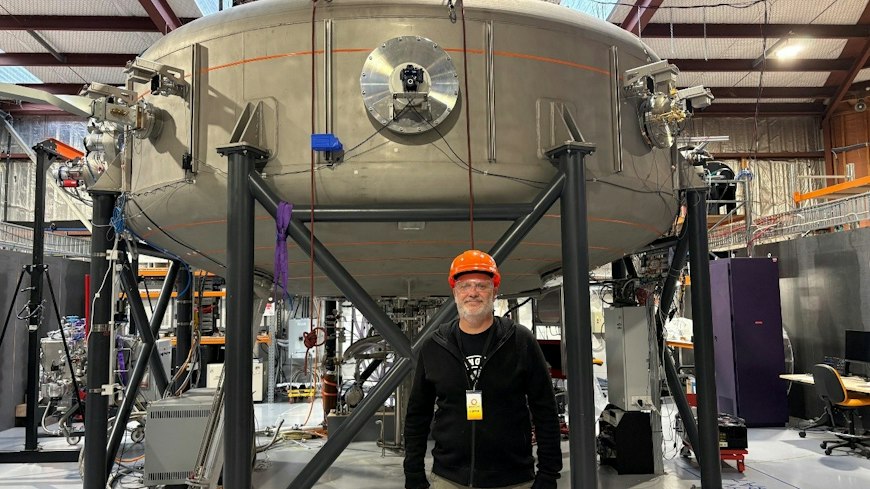
Powerswitch manager Paul Fuge in front of OpenStar’s revolutionary levitated dipole fusion reactor.
The company has already achieved several significant research milestones. It has recently attracted international attention and secured $35 million in government support for a new research facility. OpenStar believes commercial fusion applications could be possible by the mid-2030s.
If fusion can be made to work economically at scale, it could provide the holy grail of energy generation: safe, low-cost, abundant, reliable, around-the-clock electricity with virtually no greenhouse gas emissions.
However, despite the excitement and the recent rapid progress, fusion remains a technology of the future rather than a realistic solution to New Zealand’s immediate energy challenges.