By Paul Fuge
Powerswitch Manager | Pou Whakahaere Powerswitch
For more than 150 years, gas has been used in New Zealand homes. It began in the 1860s, with coal‐fired “town gas” lighting city streets and fuelling kitchens. Electricity began to take over in the late 19th and early 20th century, causing a decline in gas use, but that trend was reversed in the 1970s with the arrival of natural gas.
On this page
- Electricity or gas: Which is cheaper?
- How much could you save per year?
- The health factor with gas
- How do I electrify?
- Should I wait until my gas appliances die to replace them?
- Could biomethane be the answer?
- What about bottled gas – is it running out?
- Beware of unfair gas disconnection fees
- Saying goodbye to gas – a tricky decision to make
- Another consideration – your home’s value
In the North Island, a new network of pipelines was laid at pace, tens of thousands of homes were connected, and gas was promoted as a modern, efficient fuel. But that expansion was always built on a finite resource. New Zealand’s gas reserves are shrinking rapidly, and no major new discoveries are on the horizon.
Annual gas production is falling faster than expected – around 45% lower in 2024 than it was in the mid-2010s – and several major fields are nearing the end of their economic life. Recently, the operator of the giant Māui field, which has supplied gas since the 1970s, advised that production is now expected to cease by the end of 2026, around a year earlier than previously forecast.
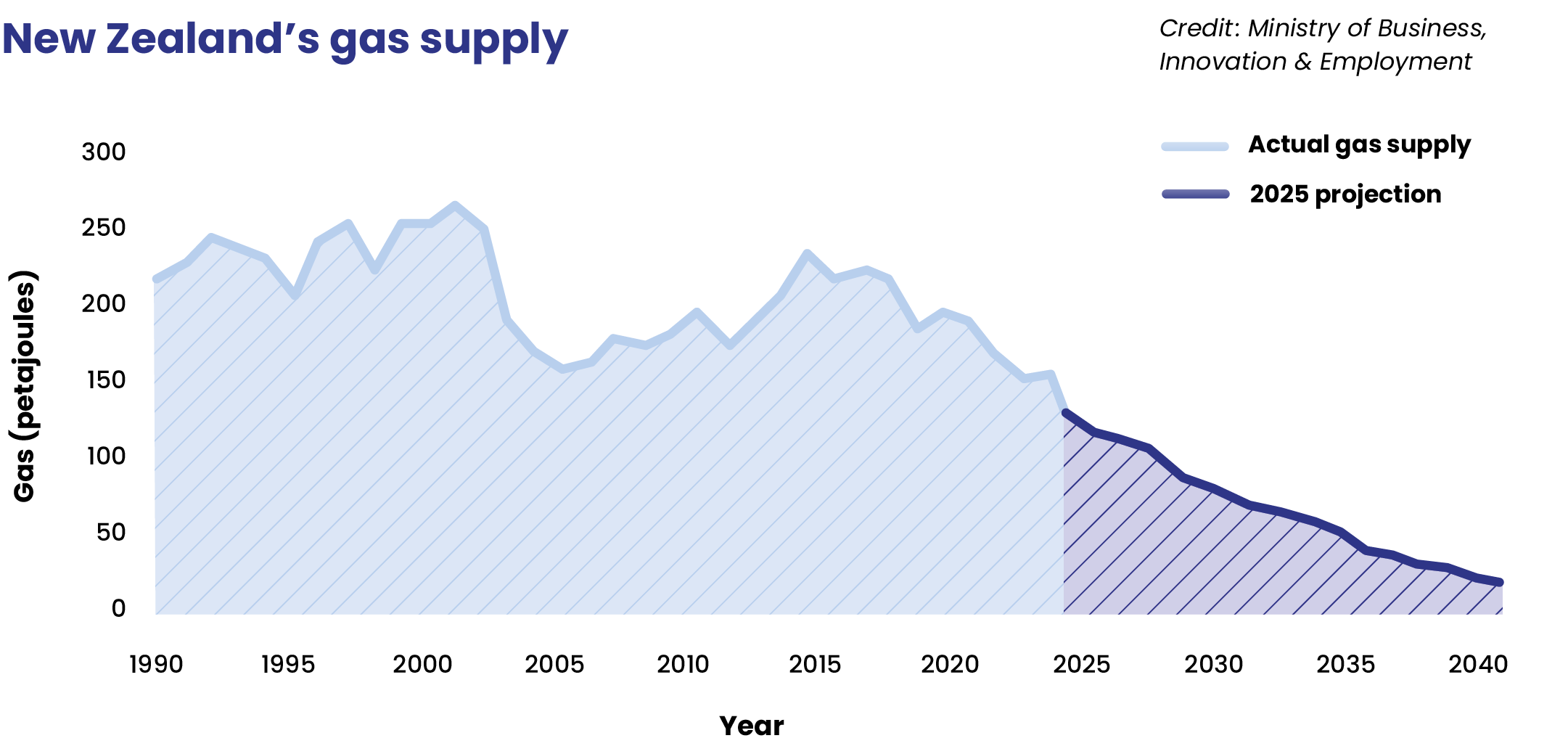
Despite years of exploration, it’s becoming increasingly unlikely that new discoveries will fill the gap. That’s not for lack of effort. Since 2012, around 50 additional wells have been drilled in New Zealand, at a cost of roughly $1.5 billion. Unfortunately, little additional gas has been found – certainly not enough to change the supply outlook.
A spokesperson from Vector, which operates the Auckland gas network, says, “Our forecasts indicate there will be no new [household] connections from 2029 onwards. Given the uncertainty around future demand, we’re prioritising operational spending to maintain and safely run the existing network, rather than making significant long-term capital investments to expand it.”
Meanwhile, around 15% of New Zealand homes still rely on natural gas. In our latest Consumer NZ survey, only 11% of gas users told us they intended to stop using gas over the next 5 years. 26% said they aimed to reduce their use but not eliminate it entirely, and 63% had no plans to stop using gas.
Our advice? Start making a plan to get off gas for good.
Note: Most of this article pertains to natural (mains) gas. The situation for LPG (gas bottles) is a bit different. See ‘What about LPG – is it running out?’
Electricity or gas: Which is cheaper?
Overall, it’s estimated that households using gas for hot water, space heating and cooking can expect to save around $1,700 per year by getting off gas. Here’s why:
Rising gas prices
It’s no secret that electricity prices are increasing, but so are natural gas prices. Last year, electricity prices rose by 12.2%, while gas prices increased by 17.5% on average.
This year, electricity price increases overtook gas, at 13.1% and 10.8% respectively. But we believe that over the long term, gas prices will increase at a faster rate than electricity, and the reason is simple. We can increase the supply of electricity by building more power stations. But, barring new discoveries, we can’t simply make more natural gas.
Households account for about 5% of New Zealand’s total gas consumption, with the remaining 95% going to commercial and industrial users. As supply decreases, competition among these powerful consumers will continue to push prices higher for everyone.
How much could you save per year?
Replacing gas heating with heat pump: $515
Replacing gas hot water with hot water heat pump: $316
Replacing gas hob with induction cooktop: $20
Removing daily charge by disconnecting gas: $830
Total annual savings: $1,681
Fixed daily charges
All homes pay a daily fixed charge for their electricity connection, which funds the poles-and-wires network that transports electricity from power stations to your home.
But homes with gas must also pay for a second, separate network – the underground gas pipeline system. The daily connection charge gas users face varies by retailer and network but is typically $1.70–$2.80 per day, with an average across the country of around $2.30. Over a year, that adds up to roughly $830 – a cost electricity-only households don’t face.
And as the customer base for gas shrinks, the fixed network costs are spread over fewer users, increasing the expense for those that remain.
The Commerce Commission, which regulates gas pipeline networks, has announced that from 1 October 2026, gas networks will be able to increase connection charges by up to $5 per month.
The Vector spokesperson says, “Gas networks need ongoing maintenance and investment to ensure they remain safe and reliable, regardless of how many people are connected. As gas demand declines, those costs will need to be shared across fewer customers, and we’re mindful of the need to balance fairness and affordability for the customers that continue to use gas.”
Fewer gas providers to choose from
Gas households also have less choice. Only a limited number of retailers offer gas – Frank Energy and Megatel both left the market in the last year, leaving only Contact, Genesis, Mercury and Nova – and some of these don’t offer gas as a stand-alone product, meaning if you want gas from them, you also have to get electricity.
That means gas households miss out on some lower-cost retailers and plans entirely.
In particular, many electricity plans offer lower rates for households that can shift electric hot water heating to off-peak times or allow retailers to control hot water cylinders. These kinds of discounts are unavailable to households using gas for water heating.
Appliance running costs
Some gas appliances are cheaper to buy than electric, which explains why they’re still being installed – especially by landlords, who only have to consider the upfront price.
However, once running costs are taken into account, the equation flips. A new hot water heat pump might cost you $7,300, compared to $4,100 for a new gas water califont. But when you add running costs over a 15-year lifespan to this purchase price, the electric option totals $9,200, while gas comes to a massive $17,500.
Electric space heating has a smaller upfront and lifetime cost. A new heat pump comes in at about $3,500, cheaper than the $5,000 you might pay for a new natural gas heater. And after 15 years, the total cost of the heat pump is $7,800. The gas heater totals $24,000, more than three times the price.
The health factor with gas
Switching off gas means cleaner air at home, fewer asthma triggers and a healthier living environment.
A recent study commissioned by the Energy Efficiency and Conservation Authority (EECA) found that using gas appliances, especially gas cooktops, inside our homes can worsen indoor air quality. When gas is burned for cooking, it releases pollutants such as nitrogen dioxide and other irritants, which can build up indoors even when you use a rangehood or open your windows.
The research shows this pollution can irritate the lungs and may be linked to higher rates of asthma and other respiratory issues, with children particularly affected. Electric appliances avoid these combustion fumes completely.
How do I electrify?
Mike Casey, chief executive of the energy advocacy group Rewiring Aotearoa, says the recent fuel shocks have pushed electrification into the mainstream.
“What we’re seeing is that decisions people have been quietly mulling over, like buying an EV, installing solar or getting off gas, are now dinner- table conversations. The fuel crisis has brought them into sharp focus. That’s driving an acceleration.
“More households are choosing to electrify to cut costs and protect themselves from volatile fuel prices by moving to more New Zealand–made energy.”
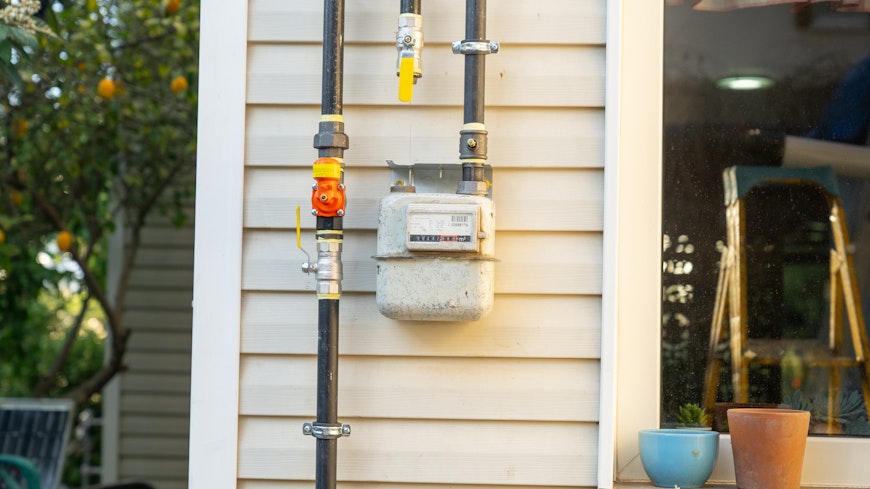
If you have a natural gas supply, you probably use it for water heating, space heating, cooking or all three. In terms of potential cost-savings, hot water and space heating have the biggest impact – they each account for roughly 30% of overall household energy consumption, compared to cooking’s 7%. Here’s our guide to going electric for all three.
Water heating
If you have a gas califont (that rectangular box on your house that heats water instantly as you turn on the tap, instead of storing hot water in a tank) or a gas hot water cylinder, you’ll need to replace it with an electric system.
The simplest and lowest-cost option is a standard electric hot water cylinder, with outdoor models available if space is tight.
But if you can afford a higher upfront cost, the standout option is a hot water heat pump, which heats water using far less electricity than conventional systems.
Heat pump water heaters are super-efficient. They work like a reverse fridge, pulling warmth from the air and transferring it into your water tank. For every unit of electricity they use, they produce around three to four units of heat, consuming up to 75% less energy than gas systems.
And hot water heat pump systems sit outside, so they can often be used as replacements for califont systems, if space permits.
Heat pump systems typically cost $7,000–$10,000 installed. That’s roughly double the price of a basic electric cylinder. But the savings add up, and they will more than pay for themselves over their lifetime. Households can typically save around $300 a year on hot water bills by switching from mains gas. Of course, the more hot water your household uses, the more sense the switch makes and the bigger the savings.
Chris Mardon runs Ecobulb, which helps households cut energy use and power bills through home energy assessments, efficient lighting and hot-water upgrades. He says, “Most people don’t realise heat-pump water heaters even exist, or that they’re much more efficient than gas. When we show people the numbers, they’re often surprised by just how much they can save.
“The biggest worry is running out of hot water, especially for people used to instant gas systems, but in our experience that hasn’t been a problem.”
Space heating
For homes with fixed gas heaters, replacing these with a heat pump is usually simple and relatively affordable, while delivering big savings. Heat pumps cost around a third as much to run as gas, are highly responsive, and can both heat and cool with the press of a button.
They’re also extremely efficient. In New Zealand conditions, a typical heat pump produces around three times more heat than the electricity it uses.
Transitioning away from gas central heating, however, is more complex and expensive – but not impossible. And if you plan to stay in your house for a long time and have the money to do it, it’s still cost- effective in the long term.
Homes with gas boilers feeding radiators or underfloor heating can usually convert to an air-to-water heat pump, which replaces the system’s boiler. Homes with ducted gas heating can often swap the gas furnace for a ducted heat pump, sometimes reusing existing ducts.
In older or less suitable homes, another option is to remove the gas system altogether and install multiple high-wall heat pumps to heat key rooms instead. All of these options can work, but they require good insulation, careful system design, sufficient electrical capacity, and professional installation.
Cost is the main barrier. Converting ducted gas heating typically costs $12,000–$20,000, while hydronic (hot water) heat-pump systems can range from $18,000 to $30,000 or more. The upside is much lower running costs – heat pumps use far less energy than gas, and households can often save hundreds of dollars a year on heating. If converting central heating allows a home to disconnect from gas completely, that can also avoid fixed daily gas charges.

Choosing a heat pump
We've created a step-by-step guide to finding the right heat pump for you.
Cooking
Cooking uses a relatively small amount of energy, so switching from gas to electric for your stove won’t slash your bills as dramatically as changing out your space heating or water heating. Swapping a gas hob for an induction one only shaves off around $20 a year in energy use. However, as above, the big savings comes if your cooktop is the last gas appliance in the house and you can disconnect from gas completely and avoid ongoing daily gas connection charges. Keeping an active connection just for the privilege of using a small amount of gas for cooking can cost about $830 per year.
Around 5% of gas-connected homes are in this exact situation, paying hundreds in daily charges just to keep a gas hob.
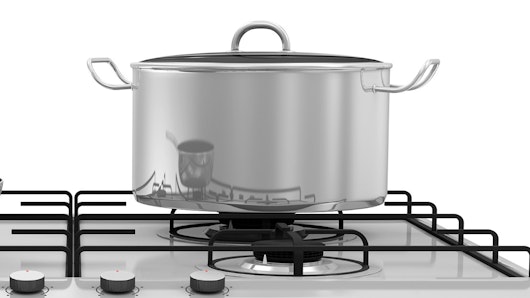
Modern electric cooktops are not only cheaper to run than gas but also cleaner and safer. There are two types, ceramic and induction.
Ceramic cooktops use a radiant heat element under the glass to transfer heat into your pots and pans. Meanwhile, an induction cooktop has a coil underneath the top that “induces” a high-frequency magnetic field in the base of your cookware. This magnetic field transfers energy into the metal in your pans, heating it up.
Induction cooktops are typically around twice as expensive as ceramic (the average price of our tested ceramic cooktops is around $1,200; for induction models, it’s $2,600).
Induction is more energy-efficient than both gas and ceramic, using less than half the energy of a comparable gas hob. Induction is 85% efficient, ceramic cooktops are around 70% efficient, and gas cooktops are around 30% efficient, meaning 70% of the gas you are paying for is wasted. Induction cooktops are also very fast. Tests show an induction hob can boil water 20–40% faster than gas.
Installing a built-in induction cooktop will require a licensed electrician. In some cases, a new circuit may need to be installed, since induction hobs draw more current than the older electric cooktops.
Installing a cooktop
If you’re installing a new cooktop, we recommend getting a quote for installation before buying one – especially if you’re moving from a gas cooktop to an induction or radiant-ceramic cooktop.
Should I wait until my gas appliances die to replace them?
It usually doesn’t make sense to rip out gas appliances that are still fairly new or have years of life left in them, unless you’re renovating and removing appliances anyway.
The smartest time to switch is when something fails or reaches the end of its life – and many New Zealand homes are already close to that point. According to EECA, around 28% of gas califonts, 50% of gas cylinders and 30% of gas cooktops are more than 10 years old. That means a lot of households will soon face a natural decision point, where replacing gas with electric is a practical option, rather than a radical one.
There’s no single right way to electrify or timeframe to do so. Each household is different. Many people simply replace appliances as they reach the end of life, spreading the cost over several years. Renovations are a great moment to think bigger, especially if you’re already upgrading wiring or insulation. If budgets allow, doing several things at once can reduce disruption and sometimes save money overall.
But for most households, electrification is a gradual process that unfolds over 5 years or more, and that’s perfectly fine. Don’t let perfection be the enemy of progress!
Could biomethane be the answer?
Gas companies are developing biomethane, a renewable gas produced by breaking down organic materials. But it won’t be a quick fix – a report presented to government by GasNZ this year says the goal is for biomethane to meet half of New Zealand’s natural gas demand by 2050.
“Right now, our focus is on maintaining and optimising the existing network for our current customers, while also progressing biomethane as a renewable alternative to natural gas,” says Don Elers, Powerco’s general manager for gas. Powerco runs the gas pipe networks across Taranaki, Horowhenua, Porirua, Wellington, Hutt Valley, Manawatū and Hawke’s Bay.
“We’ve got a dedicated renewable gas programme underway, including a project at Manawatū District Council’s wastewater treatment plant, which is now moving into front-end engineering design and aiming to be operational by 2027.”
It remains to be seen whether biomethane will one day become a cost-effective alternative to natural gas. At Consumer NZ, we’ll continue to monitor and report on all options as they become available.
What about bottled gas – is it running out?
Liquefied petroleum gas (LPG) is a mix of propane and butane – gases that become liquid under moderate pressure – and is a byproduct of natural gas processing and oil refining. It is distributed in cylinders (e.g. 9kg barbecue bottles or larger 45kg bottles delivered to homes).
Unlike pipeline gas, LPG can be readily imported if needed, so supply is not limited by New Zealand’s own gas fields’ depleting. But the same reasons for getting off gas apply – LPG bottles more expensive per unit of useful heat than electricity, and it is associated with the same indoor air quality and health issues as natural gas.
In fact, switching from LPG to electricity comes with even more potential savings.
Savings from getting off LPG
Replacing gas heating with heat pump: $1,099
Replacing gas hot water with hot water heat pump: $716
Replacing gas hob with induction cooktop: $20
Total annual savings: $1,835
Beware of unfair gas disconnection fees
For Jason and Joanne, it wasn’t the cost of using gas that got them wild – it was the cost of turning it off. They had been steadily phasing out gas as they renovated their home. But when they disconnected the final appliance, they were shocked to find that the daily charges from their gas provider – adding up to hundreds of dollars a year – didn’t stop.
They were told they still had to pay their connection fee because the meter was still in place. If they wanted to have it removed, they’d have to pay about $200 for the privilege. And we’ve seen other cases where the removal fee was not just hundreds but thousands of dollars.
We think this is fundamentally unfair. You shouldn’t have to pay ongoing charges – or a large exit fee – just to stop buying a product. The gas meter doesn’t belong to the household and, in most cases, wasn’t installed at their request. Many people inherit the gas connection when they buy a house.
Australia is treating gas disconnection as part of an orderly, planned transition – not something households should be penalised for.
In Victoria and the ACT, once a household disconnects their gas, retailers are not allowed to keep charging a daily supply charge.
In Victoria, disconnection and abolishment fees are regulated and are typically a few hundred dollars at most.
Consumer NZ believes New Zealand needs to follow suit. Gas Industry Co acknowledges this issue in its March 2026 quarterly report, saying, “We continue to engage with retailers and network owners regarding the industry’s current approach ... those parties that we have spoken to appear to agree with our view that consumers should have an option as to whether they elect to disconnect or decommission.”
Saying goodbye to gas – a tricky decision to make
Consumer NZ staff member Kirsty and her husband had already moved partway off gas, replacing an old heating system with a ducted heat pump a few years ago. But they still relied on gas for hot water and cooking.
Recently, they began noticing the smell of gas outside their home.
A plumber later found two leaks, one under the house and another beneath the garden. Because the pipes were on their property, the cost of fixing the problem fell on them. That left them with a bigger decision – stick with gas or take the opportunity to switch to electricity?
Repairing the gas line would cost around $3,000, but only if they did much of the digging themselves. Going fully electric by replacing the gas hob and hot water system would cost about $8,400 if they went for a standard hot water cylinder. Upgrading to a hot water heat pump would add about $4,500.
At the time of writing, they were still weighing up their options.
The long-term cost savings from switching are appealing, and there is a risk their existing cylinder, which is over 20 years old, could fail soon. But the higher upfront cost remains a real barrier and a reminder of how hard these decisions can be in practice.
Another consideration – your home’s value
Switching off gas isn’t just a short-term bill calculation – it’s a long-term decision about the kind of home you want to live in.
Over time, all-electric homes are expected to become increasingly cheaper to run than homes reliant on gas.
Electrifying your home is also a major capital upgrade, one that adds lasting value rather than tying you to ageing infrastructure. It’s easy to imagine a future where energy efficiency and resilience are selling points in the property market, just as insulation and double glazing are today.
Moving away from gas makes for a healthier home and planet – benefits that last well beyond the next power bill.

End high power prices now
Tell the government power bills must come down. Back our four-point plan and help us fight for cheaper power.