Our expert testers assess the latest fridge-freezers for temperature stability, evenness throughout their compartments, and much more.
Choosing which models to test
As much as we’d love to, we can’t test every fridge and fridge-freezer on the market. Testing is expensive and time consuming, and we have a limited budget.
Instead, we regularly survey the market and discuss with manufacturers which models will be discontinued, which are staying current and what new models will be released in the near future. We then make a representative selection of models for testing, including cheaper and more expensive ones, top- and bottom-mount, side-by-side and French door, as well as any models with new or interesting features.
If you don’t see the model you’re considering purchasing in our test results, try to identify a similar model by the same manufacturer, and check our predicted reliability and brand satisfaction results. If you choose a model from brand that's rated highly, you’ll likely end up with a good model.
Lifetime score
Our overall score combines test performance (how well the appliance works) with predicted reliability (how likely models from the brand are to remain free of faults) and brand satisfaction (how likely owners of the brand are to be very satisfied with their appliance).
Test performance

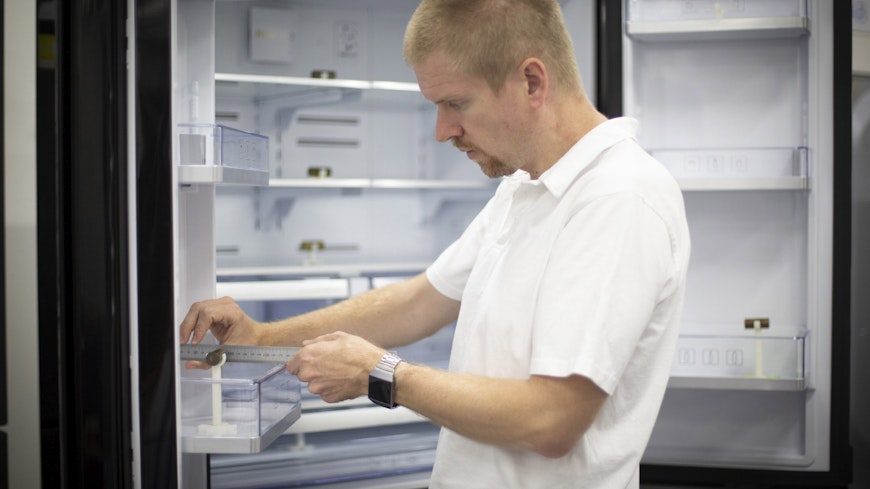
Measuring internal dimensions of fridges in our lab
It’s no good if a product lasts for several decades if it doesn’t work well in the first place. A disappointing product will soon become unloved and unwanted. For this reason, our independent lab testing forms an important part of our overall lifetime score.
Our fridges test includes:
Temperature stability
We measure how much the temperature inside the fridge fluctuates as the compressor starts and stops. The higher the score, the more stable the temperature.
Temperature evenness
We measure how even the temperature is throughout each compartment. The higher the score, the more even the temperature is.
Room temperature change response
We test how well the appliance deals with changing room temperatures. We test in a temperature-controlled room. We adjust the temperatures to simulate winter and summer conditions while monitoring the temperature inside the fridge. The higher the score, the better the fridge deals with temperature changes.
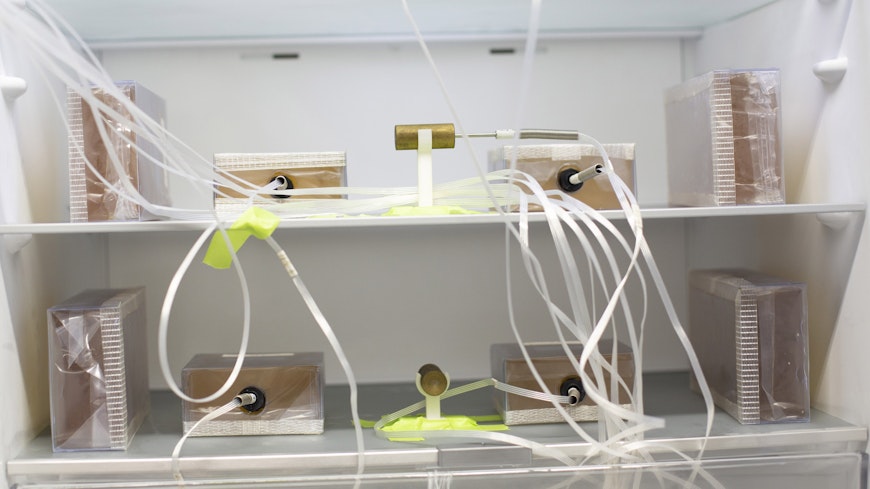
Testing temperature uniformity in fridges with multiple sensors.
Food cooling efficiency
From 2022, all models reviewed undergo a heat load test. We measure the time it takes for the fridge to cool a warm load (representative of a warm plate of food) and for the fridge to return to an even state (even temperatures). We also measure how much energy the fridge uses during the test to get an indication of how efficient it is.
Climate suitability (default settings)
Many people either won't change the fridge's default settings or will only change it when they first get the fridge. So we test how well the fridge performs for the New Zealand climate on the manufacturer's recommended settings. If there isn’t a recommended setting, we test using the factory settings or a mid setting.
Setting up temperature sensors in a fridge to monitor temperatures.
Predicted reliability
It’s reasonable to expect a new appliance to remain fault-free for at least the first five years. Our predicted reliability ratings won’t tell you whether your clothes dryer will stop working tomorrow, but it does show which brands make models that are less likely to fail.
Brand satisfaction
Satisfaction is important – no appliance should be a source of buyer regret. Appliances with very satisfied owners are more likely to get cleaned regularly and maintained well. Their owners are also more likely to seek repair for faults than look for a quick replacement.
Survey data
In our reliability and satisfaction surveys, consumers tell us about faults that have made an appliance they own unusable or mean they’ve had to change how they use it. We also ask them how satisfied they are with the appliance. We use this data to produce our predicted reliability and brand satisfaction scores.
We use a statistical test to rate the relative performance of each brand. Compared to data we have for all products (of the same type) in the survey, we rate each brand with highest, high, average, low or lowest for predicted reliability and brand satisfaction respectively.
You can compare the rating of different brands for the same product type (for example, the predicted reliability rating for Fisher & Paykel and Samsung fridge-freezers), but you can’t compare the results for different product types (for example, satisfaction of LG fridges and Samsung clothes dryers).
We analyse brands that get at least 30 responses in our survey. That means there are some brands we can’t analyse because we don’t have enough data. For those brands, we assume they have average reliability and satisfaction.
Our data is based on 2,709 responses from owners of fridges, fridge-freezers and freezers in our 2025 survey. Our next survey for these appliances is in 2027.