By Nick Gelling
Product Test Journalist | Kaipūrongo Whakamātautau Hautaonga
Two of the three network operators failed to provide customers with useful summaries of their usage. The third, One NZ, made no positive progress either.
We take a critical look at the three biggest mobile service providers each year to assess how well they empower their Pay Monthly customers to choose the right phone plan.
This year’s results are the worst we’ve seen in five years of the review.

Our ratings are now backed by official guidelines
This review is conducted in partnership with the Commerce Commission, which regulates New Zealand’s telecommunications market.
We measure mobile providers against agreements they made with the Commission in 2021, to provide each customer with:
At least 12 months of information, available through a mobile app and website, detailing how much the customer used their phone plan and how much it cost.
An annual summary of usage and spend, along with a prominent prompt to consider alternative options.
In November 2025, the Commission published the Mobile Transparency Guidelines, clarifying minimum expectations for how providers should communicate customer data “to address long-standing transparency and inertia issues within the residential mobile market”.
The guidelines took effect immediately for Pay Monthly (i.e. non-prepay) plans from the three big providers – Spark, One NZ and 2degrees. In November 2026, they will extend to prepay customers, and all other mobile providers will also be expected to comply.
The guidelines confirm that providers are expected to meet many of the same criteria our review has been assessing for years – so we’re disappointed that scores have actually dropped since they came into effect.

2degrees
Mobile app: 77%
Annual email summary: 0%
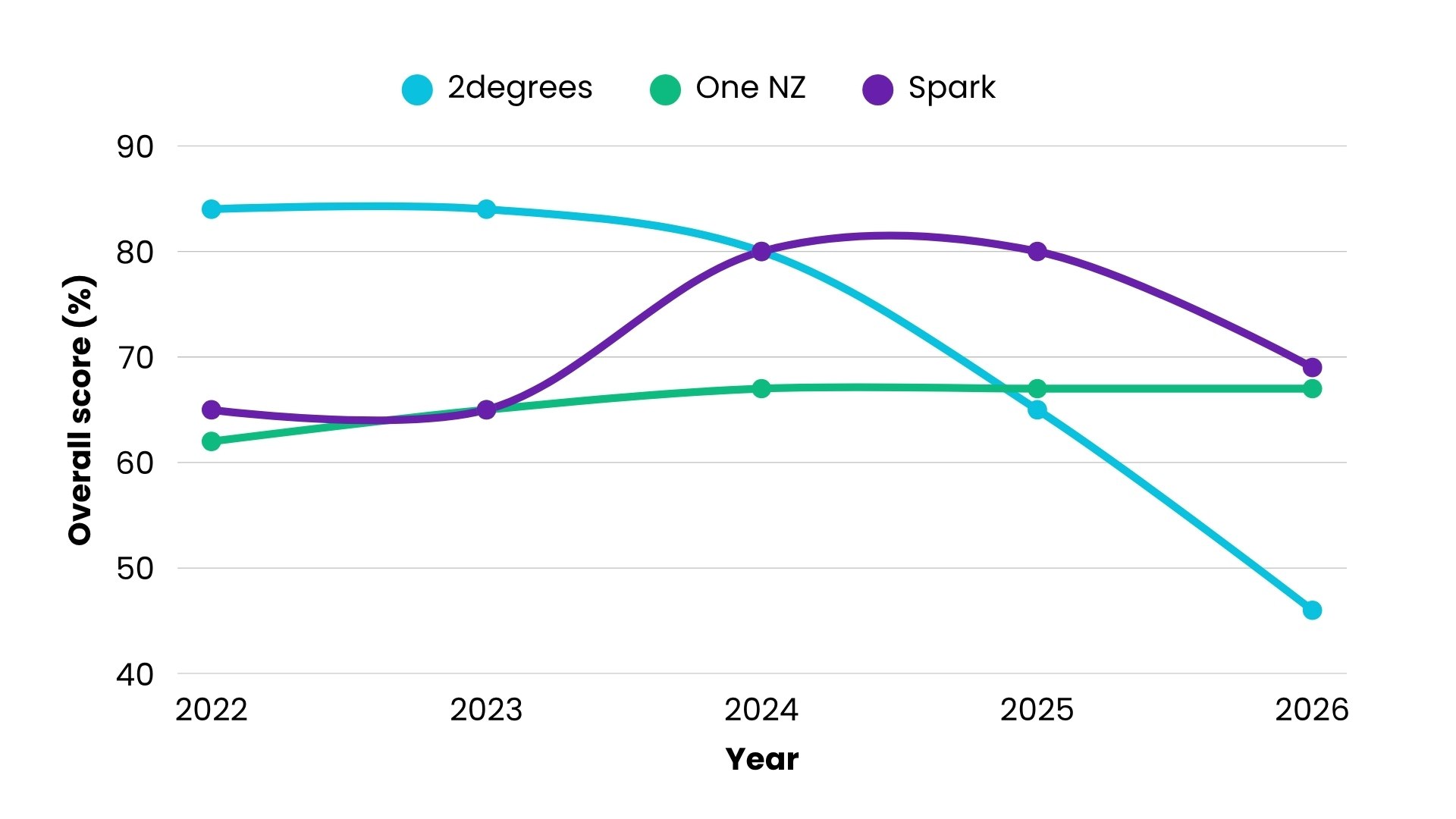
Overall: 46% (down from 65%)
This year, the country’s third-biggest mobile provider has seen the biggest rating drop in the history of our review.
2degrees failed to send any customers an annual summary of their usage and spend from July 2025 to July 2026, while it fixed data issues stemming from a new IT platform. This pause included the entirety of our review period, so we are forced to give 2degrees a rating of 0%.
Annual summaries are a crucial part of keeping customers informed about whether they could be getting a better deal, so skipping them for an entire year is not a good look.
The email has been relaunched now. It looks serviceable, while not meeting all of the Commission’s expectations. Namely, it aggregates information over the whole year (dividing by 12 to get monthly averages), rather than reporting actual monthly usage.
It’d earn a rating of about 60% – not as good as One NZ’s summary, but better than Spark’s. If the email summaries had resumed months earlier, 2degrees’ overall score would actually have increased this year.
That’s due to gradual improvement to 2degrees’ app, which is beginning to catch up to the excellent standard of the old app it replaced in 2025.
Customers can now scroll back to see usage from more than a year ago, exceeding the 12 months required under the Commission’s guidelines.
2degrees has also made it clearer to see when chunks of mobile data will expire. This isn’t something we rate in our review, but it’s a good piece of voluntary transparency, so we give them a gold star for that.
The app’s biggest drawback is that usage can only be viewed at a daily level, which makes it much harder to see long-term trends. 2degrees assures us that future app updates will add a monthly view.

One NZ
Mobile app: 63% (no change)
Annual email summary: 74% (no change)
Overall: 67% (no change)
For the second year in a row, One NZ has made no improvements to how it shares data with customers.
Its annual “Your year in review” email remains good, now standing alone in meeting most of the Commission’s guidelines.
However, its app persistently remains behind where it needs to be. In particular, it only displays 2–3 months’ worth of historical data – not enough to make an informed decision about which plan is best for you. The guidelines say a minimum of 12 months of information should be provided.
With that said, there are promising signs. One NZ’s app now displays 12 months of information for broadband customers, and the company claims it is working to match that for mobile.

Spark
Mobile app: 85% (no change)
Annual email summary: 46% (down from 72%)
Overall: 69% (down from 80%)
Spark’s annual summary is also a major disappointment this year. Falling well short of the regulator’s expectations, Spark’s email is little more than a prompt to open the app or website, rather than itself containing any useful information.
It’s a far cry from the consumer-friendly summaries Spark was producing a couple of years ago, earning admiration in our 2024 review.
However, Spark’s overall rating is buoyed significantly by its excellent app experience, which remains mostly unchanged since last year. Spark has added a new “Recap” feature, which summarises customers’ usage on a monthly basis. Recap doesn’t include any new information, but its more visual presentation may help to engage more customers.
How the rankings have changed
This year’s result is a sorry sight for the formerly dominant 2degrees. Following its corporate merger in 2022, a change in platform has left customers far less informed than they were four years ago (keeping in mind that this year’s low will be temporary, as the email summary has been reinstated).
The recently ascendant Spark has also taken a dive and is in serious danger of losing its top spot the next time the review is repeated.
The average transparency rating among the three network operators is at its lowest point since the review began – a concerning trend for a market that was improving until recently.
Providers should help you onto better plans
None of the three operators routinely encourage low-usage customers onto a plan that better suits them. Your mobile provider knows a lot about your habits, and we think it has a duty to make sure you’re on the right plan.
Spark was experimenting with this kind of personalised service but has recently pulled back from it.
The closest we now have is One NZ’s annual summary email, which suggests that customers that use less than 1GB of data in the year consider switching to prepay. However, the email doesn’t suggest a specific plan, which is crucial to making the process easy for uncertain consumers.
We deserve better service from our mobile providers – and until we get it, regularly shopping around for a better deal is our only option.
Want more independent advice to help you shop smarter? Subscribe to the Consumer NZ newsletter and get our best stories in your inbox every week.
Was this page helpful?

Think you’re wise to online scams? Take the test

True or false? Bundled power and broadband deals are cheaper

Triumph for Windows 10 users as Microsoft extends free support