By Vanessa Pratley
Investigative Journalist | Kaipūrongo Whakatewhatewha
Your power bill could increase next year to pay for electricity infrastructure. We explain why and how much more you’ll pay.
The Commerce Commission is proposing increased revenue limits for key players in our electricity industry. It says the increases are required to fund necessary investment in Aotearoa’s electricity network.
However, the proposed investment will hit consumers in the pocket. Specifically, it will add an average of $15 to monthly electricity bills from 1 April 2025. This could be lower or higher depending on where you live.
Under the proposal, national grid owner Transpower would see an allowable revenue increase of 43%. Local lines companies would also get an increase of 50%. The increase reflects the higher costs facing the companies and the cost of maintaining and replacing older infrastructure.
Commissioner Vhari McWha said the costs to consumers are necessary to prevent further price hikes down the line.
“As an essential service for all Kiwis, the affordability of electricity is important. We’re conscious that for consumers to get the electricity network they need, more investment is required.”
McWha said the Commission didn’t allow all the expenditure forecast by Transpower and lines companies to be passed onto consumers. The Commission had also lessened the impact on consumers by spreading the increases over the regulatory term, she said.
More increases on the horizon
We spoke to our resident power expert and Powerswitch manager, Paul Fuge, who explained what costs make up our electricity bills.
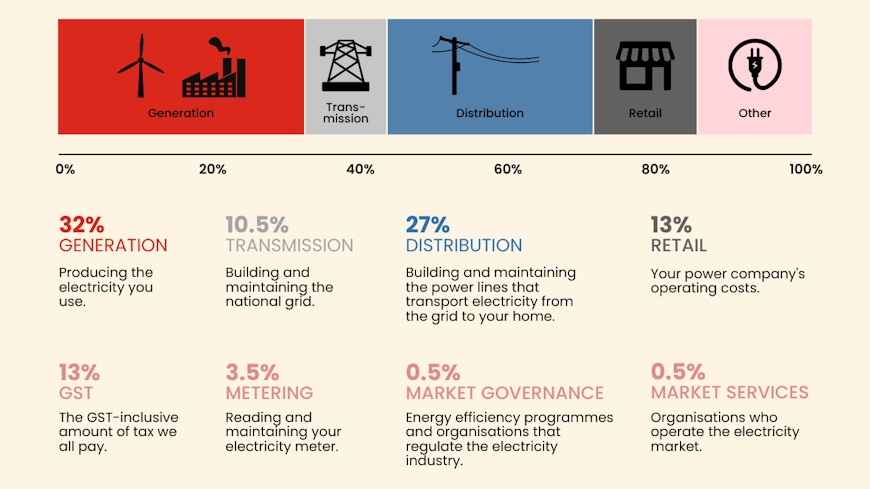
Transmission costs and lines company distribution costs make up 10.5% and 27% of the average consumer power bill, respectively, says Fuge.
He warns that the increase to these parts of the average bill won’t be the only increases for consumers over the coming years.
The wholesale cost of electricity makes up around 30% of household bills. Fuge says the price of electricity is likely to change in the future, which will further impact bills.
Data source: Electricity Authority
“Other changes in the electricity sector – notably the price of electricity itself, and the continued roll out of low user charges – will further affect bills. Given the high prices in the electricity wholesale market, we expect the retail price of electricity will also eventually increase.”
How to reduce your electricity bill
The announcement comes during a cost-of-living crisis and at a time when consumers are facing increased costs across the board. Yet Fuge says there are practical steps you can take to ease the burden power bills have on your wallet.
“Forty five percent of consumers have not changed power provider for at least 5 years, with a staggering 26% of consumers being with the same suppler for more than 10. The average saving through changing provider is $409.”
Fuge says using Consumer NZ’s free Powerswitch service makes comparing providers and switching easy. Fuge also says the increasing price of electricity makes solar and other energy efficient appliances more attractive.
The Commission is seeking feedback on its draft proposal before releasing a final decision by 30 November 2024.
Electricity network glossary
Transpower: owns and operates the national grid. This includes looking after the assets that comprise the grid and managing how electricity gets to homes and businesses.
National grid: the nation-wide system of pylons and substations, used for transmission.
Transmission: getting power from the point of generation, like a hydroelectric dam or wind farm, to your local area.
Lines company: sometimes referred to as the local distributor or electricity distribution business, takes the electricity from the national grid and delivers it to your home or business. Lines companies are responsible for maintaining poles and lines in your community and fixing outages or faults.
Distribution: getting power from the grid to your home.
Retailer: the business that sells you electricity.
Are you paying too much for power?
We'll help you compare and find the best electricity and gas plan. Check now to see if you’re getting the best deal.