
By Claire Peacock
Digital Journalist | Kairīpoata Matahiko
Would you feel comfortable sending a photo of yourself in your underwear to a complete stranger? That’s the situation Sarah (not her real name) was faced with when she complained about the construction of a bra she’d purchased online.
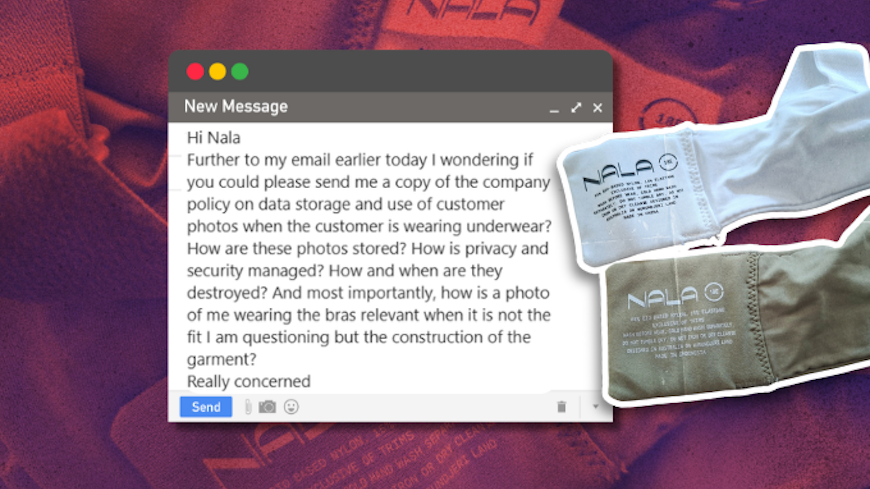
A while back, a friend gave Sarah some bras made by Australian brand Nala.
Nala markets itself as committed to sustainability, diversity and inclusivity. It leans heavily into online marketing, with its influencer partnerships and body-positive social media campaigns flooding Instagram and Facebook feeds.
Sarah loved the ones she’d been given and wore them all the time, so when she needed a new bra she knew just where to turn.
“When I needed another bra, I bought a Nala one with an underwire, in a nude colour. It arrived and I really liked it – it was one of the best underwire bras I’ve had in a while, so thought I’d get some more.”
Just a fortnight later, she ordered three more.
“I went back to Nala and ordered three of the exact same bras I had bought just two weeks earlier, in different colours. When they arrived, I wore one but it was so uncomfortable that I had to take it off in my car on my way home.”
Sarah compared the new, uncomfortable bra side by side with the one she’d bought two weeks prior.
“I could see the underwire was a completely different size – in the older one, the underwire was encased wholly within its pocket, whereas in the new one the underwire was much smaller and was slipping around.”
She hopped onto the Nala website to complain – she couldn’t see anything about its refunds process, but sent a message via a feedback form to outline what happened, and offered to send photos of the two bras next to each other clearly showing the construction discrepancy.
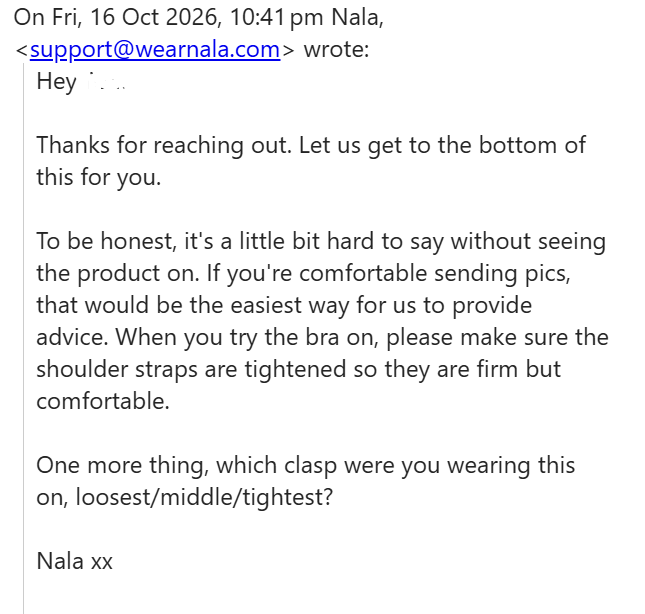
“I got a reply that queried whether I’d adjusted the straps correctly, and asked me to send through some photos of me wearing the bra,” she says. “And I just thought, hang on, it’s not a fit issue – it’s a construction issue.”
Need our help?
If something’s gone wrong with a product or service, our Consumer Rights Advice Line experts can help you get a fair deal.
Get personal, practical advice you can trust – included when you join from $15 a month.
‘Can you send us a photo wearing the bra?’
She was taken aback by the request and had some questions about what Nala planned to do with the photos.
“Who’s going be looking at these pictures? What are they going to be used for? Could they be fed into some kind of AI thing that we don’t know about? How long will Nala hold on to the photos?” she says. “I asked Nala all those questions, and next thing you know they got back to me, completely ignoring my questions but telling me to follow a link for a full refund.”
While she was relieved to get her money back in this case, Sarah remains concerned about Nala’s business practices.
Not an isolated experience
“For me, it was never a question of whether I would send that photo – I just would never. But someone from a younger generation, who has grown up in digital spaces and sees a lot of influencers in bras on social media, may think that emailing a stranger a photo of yourself in your underwear is normal. It’s not normal,” Sarah says. “To me, it’s completely out of line for a company to be asking for this kind of image, especially in light of their inability to give me any kind of safeguards over what would happen to those photos.”
She isn’t alone – other Nala customers have raised the same issue.
“I am just shocked at their response,” said one Reddit user. “In what world would I send them a picture via EMAIL OF ME IN THE BRAS???!!!! I don’t even know how to respond. Of course I am not comfortable sending pictures of myself to some randoms in a bra???”
Another wrote it was “definitely sketch af that they’re asking for photos!”
Consumer NZ has tried to contact Nala for a response, hoping to find out what its policies are on asking for photos of customers in their underwear, and how the company then uses and store any photos received. We have not had a reply.
‘They’re asking for too much’
So is it appropriate for a company to be asking customers for photos like that?
Professor Annette Mills, from the University of Canterbury’s Department of Accounting and Information Systems, researches how information technology affects people, with a particular focus on privacy. She says in this case, Nala is going too far.
“Obviously what they're doing is asking for an intimate image that I don't think in this instance is necessary to see what's wrong with the product. They are asking for too much, and it raises privacy issues,” she says.
“They need to establish whether there's a discrepancy or not between the most recent ones she bought, and the original one. A photo of [Sarah] wearing a bra that doesn’t fit does not necessarily deal with the manufacturing problem, based on her explanations.
Professor Mills says there are far less intrusive ways of getting information about the discrepancy between the two garments than asking for an intimate photograph.
“I think that’s an unreasonably intrusive request because they don’t need that sort of intimate image to establish the issue. Even if she cropped out her face, that doesn’t necessarily make it anonymous because that photograph would be linked to her order and her email address.”
Nala’s lack of clarity over how it uses and stores such images is also a red flag for Professor Mills.
“When you're dealing with sensitive information like this, then you have to take a lot more care when you're collecting it. You have to be very transparent about storage security, who has access to it, and how it might be used in the future.”
Consumers aren’t content creators
Sarah says her experience has made her a lot more wary about buying from companies that advertise heavily on social media and use influencers to sell their products.
“To me, an influencer might be happy to show their body and underwear on social media, but they're also getting a kickback from it,” she says. “But Nala seems to have gone the next step forward in asking for photos from everyday consumers, who haven't necessarily walked into it with open eyes of what could happen to those photos and where they could end up going. And that's really concerning.”


