By Nick Gelling
Product Test Journalist | Kaipūrongo Whakamātautau Hautaonga
They’re slim and quiet and provide background warmth by natural airflow. And, increasingly, panel heaters from the likes of Goldair, Arlec and Nobo are becoming smart, meaning you can control them over the internet.
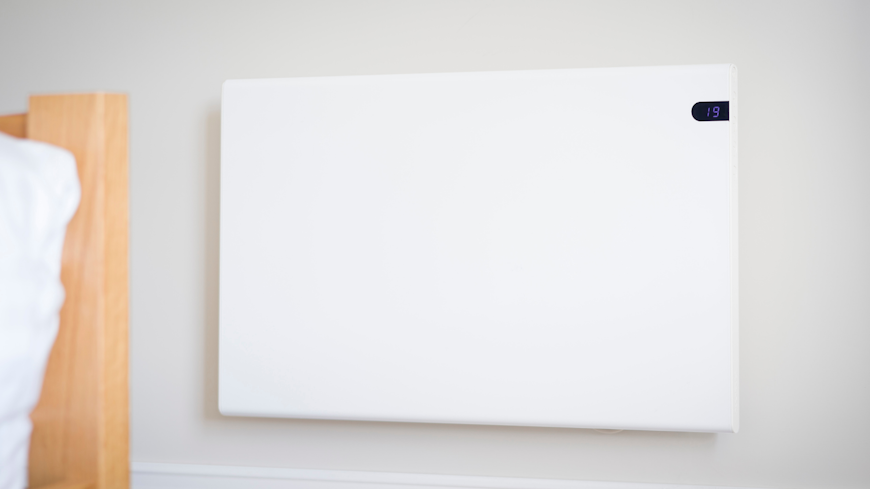
Unlike some other smart appliances, Wi-Fi panel heaters offer real benefits – they’re convenient, versatile and quiet. But there are drawbacks to this style too. They’re more expensive to run than heat pumps and wood burners, and they often heat the room unevenly. So, next time you’re in Mitre 10 or Briscoes, is it worth swapping out your old oil column or tower heater for a Wi-Fi panel?
The upsides of a Wi-Fi panel heater
You can control them remotely. Smart heaters can be adjusted while on the couch or in the next room. You can even switch them on or off and adjust the thermostat using voice commands.
You can program them to operate automatically. Using a mobile app, you can set routines to raise or lower temperatures at certain times of the day without having to lift a finger. That way, you can turn on the heat before you wake up or turn it off after you’re asleep. Even if you’re not great with technology, we reckon it’s easy enough to figure out. Heaters without Wi-Fi have timers too, but apps are easier to use and have more advanced options.
They’re very quiet. Because panel heaters tend to operate via natural air convection, they are nearly silent to operate. Most tower and ceramic heaters make noise, because they use fans.
They can be attached to the wall. A modern panel heater is versatile. You can either hang it off a wall bracket or attach wheels or feet so you can shift it from room to room.

Compare electric heaters
Keep warm with one of our tested heaters. We’ve tested all types of plug-ins including oscillating towers, micathermics, convection, fan and oil-column.
The downsides of a Wi-Fi panel heater
They’re not as cheap to run as fixed heating options, like heat pumps and wood burners. All plug-in electric heaters are as efficient as one another, and significantly more costly than the cheapest ways to heat your home. If you’re not planning to move your panel heater, and you own your home, a Wi-Fi heat pump might be a better option.
Most don’t spread heat as evenly as other heaters. Panel heaters that lack a fan don’t circulate hot air as effectively as heat pumps or fan-forced plug-in heaters. You might end up with warm and cold pockets in the room. Because of this, panel heaters don’t always perform as well in our lab testing. However, our favourite panel heater earned a Recommended tick despite being fanless (see The best Wi-Fi panel heaters we’ve tested).
Remote operation could be a safety risk. Smart panel heaters, like all electric heaters, are designed to switch off if they get too hot or if they get knocked over, which should prevent most fires. However, experts still advise against running a heater unsupervised. If you’ll be nervous running a heater while you’re not home, it nullifies one of the main appeals of Wi-Fi connectivity.
What to look for when buying a Wi-Fi panel heater
Check which mobile app the heater is compatible with. Download the app before you buy the heater, and see if it seems easy to use and has the features you want.
Decide on the correct wattage for the room/space you’re trying to heat. The most powerful panel heaters are 2400W, which suits a medium-sized room (about 20m²). If your space is smaller or very well insulated, a 2000W heater should be enough. Panel heaters don’t tend to be any smaller than 2000W.
Some panel heaters have a built-in fan that can be switched on and off. Because the fan makes noise, you won’t want to use it all the time, but it can be useful when you need to heat a room quickly and evenly.