We put dishwashers through a series of rigorous tests to see which machines are the best.
Lifetime score
Our overall score combines test performance (how well the appliance works) with predicted reliability (how likely appliances of that brand are to remain free of faults) and brand satisfaction (how likely owners of appliances of that brand are to be very satisfied).
We’ll only recommend appliances you’ll love to own, that work well and keep working well for a long time.

Test performance
Washing
We assess how well the dishwashers can remove food such as oats, spinach, egg yolk, baby cereal, butter, tomato juice and tea stains, which have been dried overnight, and without being rinsed first. Our test is based partly on established international standards.
Drying
This score reflects how dry the dishes are 30 minutes after the normal cycle has finished. During this time, the dishwasher’s door is left closed, unless the dishwasher has an automatic door-opening function that is activated at the end of the programme.
Energy efficiency
This is based on the amount of energy the dishwasher uses per place setting on the tested programme. The less energy used, the higher (better) the score.
Predicted reliability
It’s reasonable to expect a new appliance to remain fault-free for at least the first 5 years. Our predicted reliability won’t tell you whether the dishwasher will stop working tomorrow, but it does show which brands make models that are less likely to fail.
Brand satisfaction
Satisfaction is important – no appliance should be a source of buyer regret. Appliances with very satisfied owners are more likely to get cleaned regularly and maintained well. Their owners are also more likely to seek repair for faults than look for a quick replacement.
How we test dishwashers
The items used for a test load need to be the same every time and have the same amounts of the same types of food on them. There also needs to be consistency in how many items are loaded into dishwashers of various sizes.

Our testers check how well the dishwashers tackle a full load of dirty dishes by measuring out equal amounts of steam-baked oats, egg yolk, spinach, baby cereal, butter, tomato juice and tea on to our standardised set of crockery. They also put egg yolk on to cutlery. We then let the crockery and cutlery dry for 15 to 18 hours before putting them in the dishwasher.
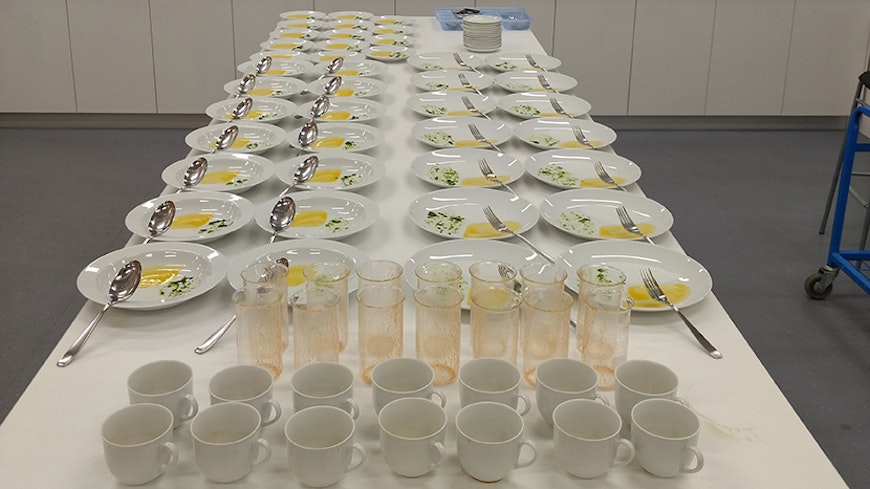
Each of the foods we use plays a crucial part in assessing how the dishwasher performs, testing things like filtration, spray-arm effectiveness, rinsing and automatic sensors.
We put each dishwasher through its paces at least twice and the scores are averaged. Testers also measure the energy and volume of water used in a cycle.
The laboratory we test in is up to date with the latest reference machines and calibrated measurement tools to bring you the right results. Everything in the lab is tightly controlled, including temperature, humidity, water temperature and even water hardness, to ensure each machine is tested under exactly the same conditions.
Test programme selection
If a machine has an “auto” cycle, we select it over the “normal” cycle. We do this because an auto or sensing cycle should be designed to give optimum results for every wash. And generally, you’re paying extra for this feature.
If there’s no auto cycle, we test on the normal cycle, as this is what our members use the most.
Our survey data
In our annual reliability and satisfaction survey, consumers tell us about faults that have left an appliance they own unusable or mean they’ve had to change how they use it. We also ask them how satisfied they are with the appliance. We use their data to produce our predicted reliability and brand satisfaction scores.
We use a statistical test to rate the relative performance of each brand. Compared with the data we have for all products of the same type from the survey, we rate each brand as highest, high, average, low and lowest for its reliability and satisfaction.
You can compare the ratings for different brands of the same product type (for example, the reliability ratings for Miele and Bosch dishwashers), but you can’t compare the results for different product types (for example, satisfaction with LG TVs and Samsung phones).
We analyse brands that get at least 30 responses in our survey. That means there are some brands we can’t analyse because we don’t have enough data. For those brands, we assume they have average predicted reliability and brand satisfaction.
Our current ratings are based on data from responses about 2,336 dishwashers in our 2024 survey.