Keep toasty warm during winter with the right woodburner.
Your local council might have rules that restrict what type of woodburner you can install. Yet, if you choose correctly, you’ll be beating the winter blues for years to come.
Choosing a woodburner
It can feel daunting when you first look at our woodburner database. Use these tips to narrow down your choices and identify your ideal model.
Pollution and emissions
National Environmental Standards clean-air check
If you live on a property smaller than 2 hectares, then you need to install a woodburner that meets National Environmental Standards (NES) for emissions and efficiency, also known as clean air or urban models.
Most woodburners in our database are NES-compliant, meaning they have emissions of 1.5g/kg or lower and an efficiency of at least 65%. But, depending on where you live, NES compliance might not be enough. Some parts of the Bay of Plenty, Hawke’s Bay, Nelson, Canterbury or Central Otago can be much stricter about emissions.
Models with high efficiency give more bang for your buck with fuel, extracting more useful heat from each log. Choosing a model with low emissions means less risk of your chimney producing smoke that causes respiratory issues and stinks up your street.
Our emissions and efficiency scores simplify the measurements, making it easier to compare models. They give an indication of the relative performance of each woodburner – a score above 70% indicates above-average performance.
Ultra-low-emission burners
Ultra-low-emission burners (ULEBs) are a technology designed to be installed in areas where older burners are outlawed. These burners meet stringent standards and can be installed in clean-air zones where all other fires are prohibited. They’re also highly efficient.
Rural models
Woodburners that are allowed on sections larger than 2 hectares are also available. They generally offer better overnight-burn capability than urban models, making them ideal for farmers who still want their fire to be blasting when they wake up early in the morning. The trade-off is higher emissions and lower efficiency.
Fit check
Will it be powerful enough?
Working out the heating capacity (kW) required for your home is critical. Woodburners lack the fine control of a heat pump – too small and your burner won’t keep your home at a healthy temperature; too large and you risk turning your home into an oven.
As a rough guide, models under 10kW are best suited for smaller, well-insulated spaces, while large and/or poorly insulated spaces need more than 10kW. For a more accurate gauge on the ideal output for the area you want to heat, use our calculator below.
Freestanding or insert?
If you have an existing open fireplace, you can opt for an insert woodburner that fits inside the old fire cavity. Freestanding models are the best option for newer households, and can now be placed closer to walls, with smaller clearances than older freestanding models.
Radiant or convector?
Radiant fires offer an intense, toasty heating effect, ideal if you’ve got high ceilings or poor insulation. Convector fires produce a softer, ambient heat through a cyclic convection effect. They heat more evenly, but are better for homes with good insulation and low ceilings.
If you’re not sure what’s best, many models are “radiant and convection”, combining both heating modes.
Price
Woodburners range in price from $1,000 to more than $5,000. You should also factor in the cost of installation and building consents (usually several hundred dollars more) when buying one. ULEBs tend to be more expensive burners, but their greater efficiency means you’ll spend less on firewood in the long term.
Aesthetics
Looks can be important and some woodburners have much larger windows than others, which can enhance your living area’s ambience. Others have a variety of coloured panels. Some ULEBs even have a USB charging port – just remember to NOT put your devices on the woodburner while charging. Insert woodburners often have varying fascia mimicking the detailing of old fireplaces.
How woodburners work
It’s a two-stage process!
First, if the wood is hot enough, the combustible creosotes and resins will evaporate out of the timber and be burnt as gases (if these gases are not burnt completely the result is smoke).
The evaporation of the gases turns the wood to charcoal, which then burns easily and cleanly – and produces most of the heat.
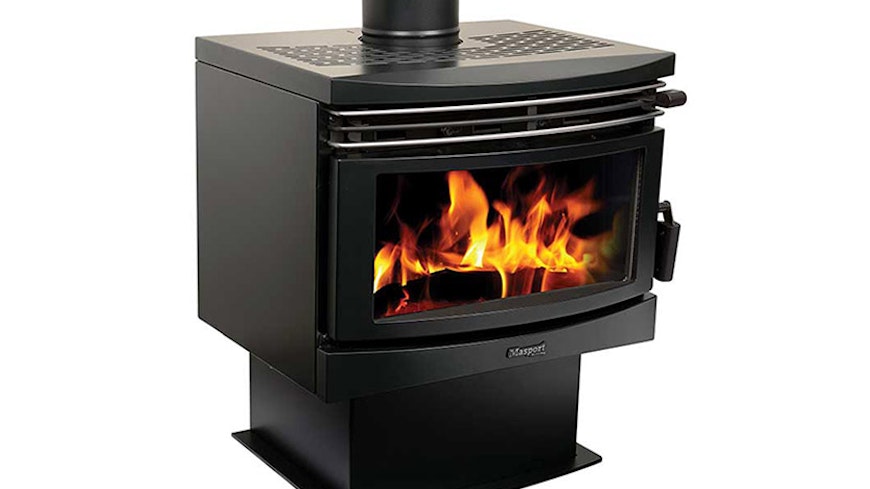
To burn as cleanly as possible, the fire needs to be as hot as possible. It also needs the right amount of air to support the combustion. Too much air cools the fire and smoke is produced. Not enough air has the same effect.
Modern woodburners burn efficiently because their fireboxes are lined with firebrick material, making for a hotter fire. The air is carefully admitted, giving the most complete combustion possible. The resulting efficiency (conversion of the fuel energy into heat in the room) is around 65%.
Contrast this to the traditional open fire, which admits far too much air, cooling the fire and giving an efficiency of 15 to 20%. Some fireplaces even have negative efficiency – they draw cool air into the house, warm it and send it up the chimney!
What size woodburner?
Calculate the right size woodburner for the area you want to heat. Measure the floor and ceiling areas in square meters (length times width in metres). Usually the ceiling area is the same as the floor. Measure the wall and window areas in square meters (height times width in metres). Enter the areas you have measured into the calculator below.
Wetbacks and heat-transfer systems
Woodburners for urban areas have to comply with the National Environmental Standards (NES), which means they must have a minimum "space-heating efficiency" of 65%.
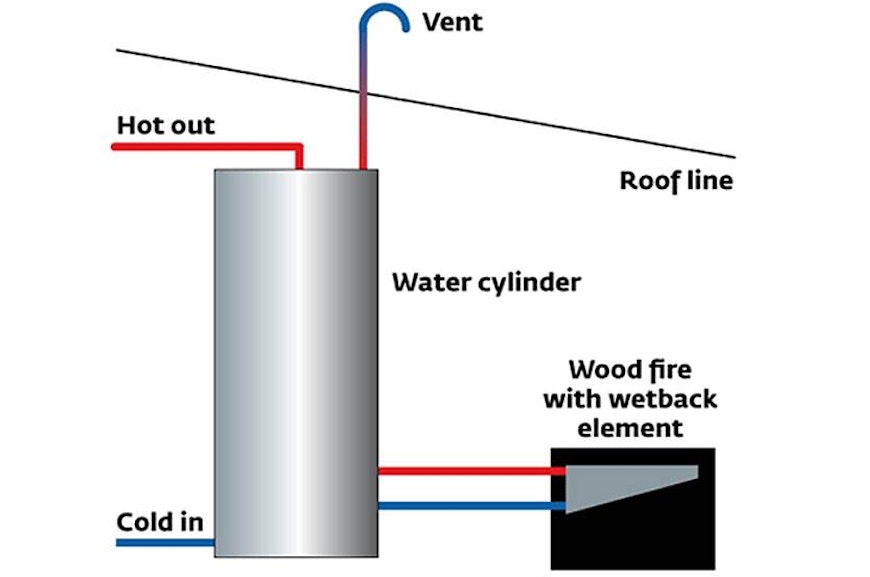
"Space-heating efficiency" is the efficiency of converting the wood's heat energy into space (air) heat. The water heating from the wetback isn't included in the efficiency calculation – so when some of the wood's energy is going into water heating it means that relatively less is going into space heating.
This means that some woodburners are compliant without a wetback but not compliant when fitted with one. This is because the heat removed by the wetback reduces the woodburner’s efficiency to below 65%.
Wetbacks are expensive to install and require the hot water cylinder to be placed reasonably close to the burner. The payback period for a wetback depends on how you use your woodburner. If the woodburner is not used every day, a wetback is unlikely to be cost effective.
One problem with woodburners is they can over-heat the lounge while the rest of the house remains cold. This isn’t healthy. The most common commercially available heat-transfer systems use ducting to move warm air. We think the rule on wetback “efficiency” is holding back development of woodburner systems that could distribute heat around the house using a wetback and water radiators.
Tip: If your house is not open plan, think seriously about installing a heat-transfer system.
What about a pellet burner?
Pellet burners have some real advantages – if you can source pellets at a reasonable price. Find out what to look for and compare models.
Annual woodburner readiness checklist
It’s best to check your woodburners as early as you can, so you have plenty of time to fix any issues before winter rolls around.
Spring
Order next year’s wood and stack it (if dry).
Book a chimney sweep for Autumn. Chimney sweeps can book out early.
Summer
Check wood is dry enough. If not, make sure it has plenty of air flow, so it seasons.
Check that the firebricks and any grate or baffle plate inside the fire box are in good condition.
Check for worn or split door seals.
Check the glass window for chips or cracks.
Autumn
Clean the chimney – your house insurance may require it (check your policy).
Check that the air control knobs or levers move smoothly.
Stock up on kindling; otherwise get the hatchet out.
Get a woodburner fan. These can help spread the heat around your home, especially open plan ones.
Get a metal ash bucket (not a plastic one) and scoop.
What to do with the ash?
Disposing of ash can be a messy job, but it can also be a dangerous one if not done correctly.
Don’t use a plastic or wooden scoop or bucket. Only use metal ones.
Make sure there are no live coals in the ash – preferably empty it well after the fire last went out.
Don’t place the ash in a rubbish bin until it’s had a few days to cool down outside and shows no sign of igniting.
Store any ash well away from structures such as your house to avoid accidental damage if it does ignite.
Use ash to fertilise your lemon tree or roses or add it to your compost. Make sure it’s cool first.
Useful links
Ministry for the Environment
Authorised woodburners
www.mfe.govt.nzEnvironment Canterbury
Authorised woodburners
www.ecan.govt.nzNelson City Council
Authorised woodburners
www.nelsoncitycouncil.co.nzWood Energy
Wood pellet producers and stockists
www.woodpellets.org.nz
Respiratory illness and burners
If someone in your home has a respiratory illness such as asthma or COPD (chronic obstructive pulmonary disease) then see our article Burners and respiratory illness for what to look for when buying a new burner and how you can reduce pollution in your home.