By Belinda Castles
Researcher | Kairangahau
We analysed the online prices of a basket of 16 grocery items, across eight weeks and four cities, to find New Zealand’s cheapest supermarket. Our basket included everyday items such as milk, bread, toilet paper, washing powder, peanut butter and baked beans.
We found that:
Pak’nSave had the cheapest overall food prices.
New World and Woolworths had very similar average prices for loyalty programme members. For non-members, New World was significantly more expensive.
Belonging to the loyalty programme made a big difference at New World (non-members paid about 8% more on average) but barely any difference at Woolworths (non-members paid about 1% more on average).
Some items that were on special for loyalty programme members at New World and Woolworths were still cheaper at Pak’nSave.
Even though New World and Pak’nSave are both owned by Foodstuffs, home-brand products (Pams and Pams Value) cost slightly less at Pak’nSave.
Some items were “on special” more often than they weren’t – meaning the lower price wasn’t “special” at all.
Some specials did reflect genuinely big discounts, showing how important it is to shop around.
Read more about our investigation below.
Which supermarket is the cheapest?
Pak’nSave – with its claim of having “New Zealand’s lowest food prices” – was indeed the cheapest store in our survey in all four cities. Our basket of products was cheaper for North Island Pak’nSave shoppers.
On average, our basket of 16 products from Pak’nSave cost $84.38. That’s about $5 a week cheaper than the average cost for New World and Woolworths loyalty members – a saving of more than $250 a year.
New World customers who weren’t loyalty programme members paid the highest price at the checkout in all stores we surveyed (an average of $97 across all regions).
National average prices
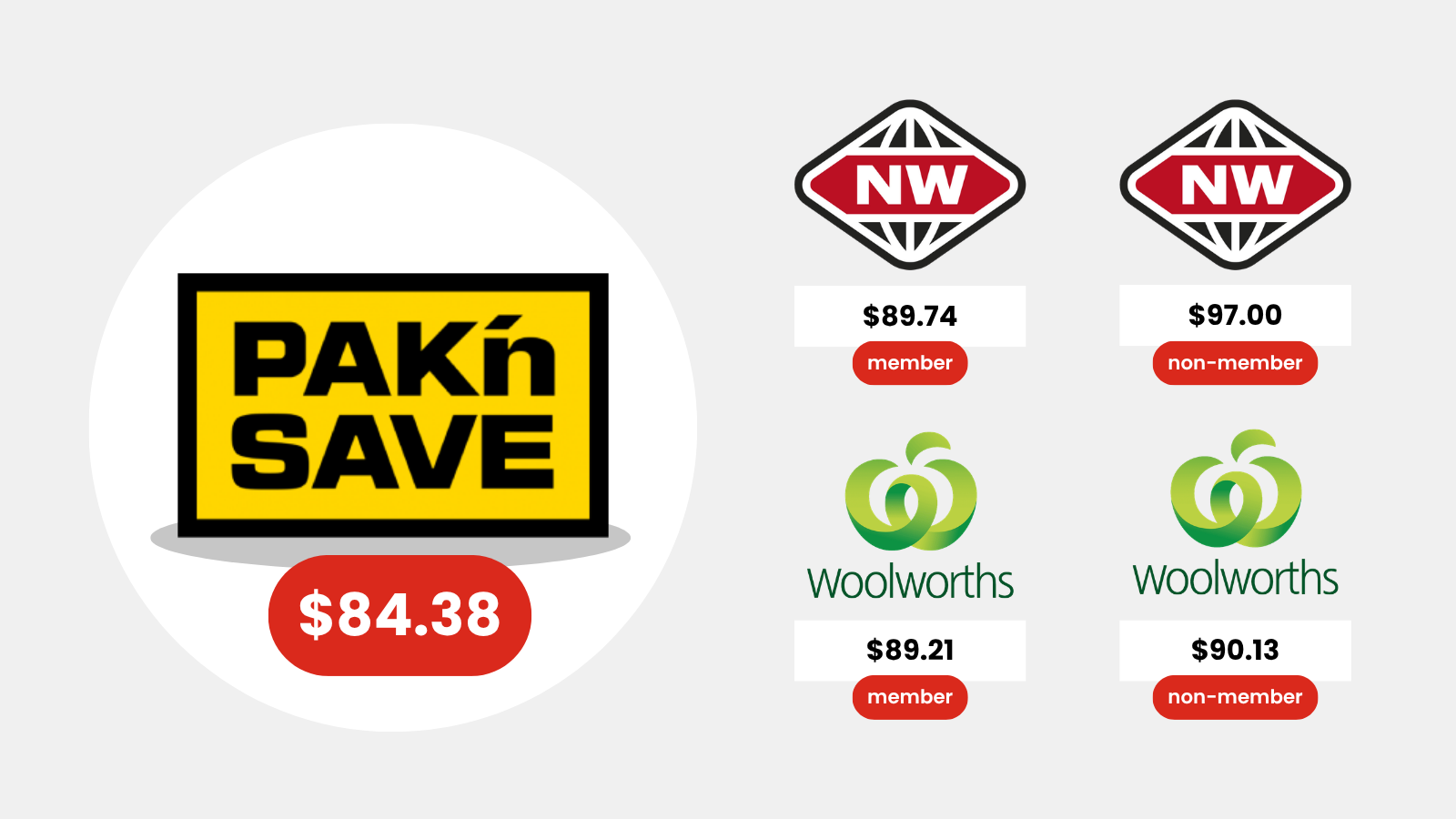
Average prices in Auckland, Wellington, Christchurch and Dunedin
We also found you’ll pay slightly less for Pams and Pams Value products at Pak’nSave than at New World.
We weren’t surprised. In our 2025 investigation into supermarket home brands, we found several examples of this trend.
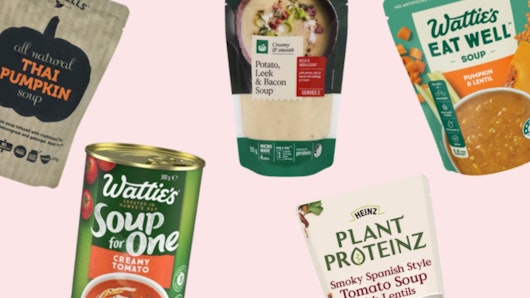
The healthiest soups at the supermarket - and ones to avoid
There are hundreds of soup options. We compared the saturated fat, sugar, sodium and dietary fibre stats of 59 ready-to-eat soups to find the best.
Our shopping list
Baked beans can 420g (cheapest per week of Wattie’s or home brand)
Bell Original black tea bags 100 pack
Blue-top milk 2L (cheapest per week of Anchor, Meadow Fresh or home brand)
Butter 500g (cheapest per week of Anchor or home brand)
Canned tomatoes 400g (cheapest per week of Wattie’s or home brand)
Edam cheese 500g (cheapest per week of Mainland or home brand)
White bread loaf 600g or 700g (cheapest per week of Nature’s Fresh or home brand)
Chelsea white sugar 1.5kg
Craig’s strawberry fruit jam 375g
McCain frozen peas 1kg
Persil Sensitive laundry powder 2kg
Pic’s smooth peanut butter 380g
Ploughman’s Bakery Country Grain bread 750g
Purex 2-ply Mega Long toilet tissue 6-pack
Sanitarium Marmite 250g
Wattie’s cream-style corn 410g
Do loyalty programmes save you money?
We calculated the savings made by Woolworths’ and New World’s loyalty card members.
Consumer’s head of research and advocacy, Gemma Rasmussen, says if you’re providing the supermarket with your personal data, purchase history and shopping habits, you should be getting a fair discount in return. But our price tracking investigation shows this isn’t always the case.
Over the eight weeks of our survey, Woolworths Everyday Rewards members saved on average less than $1 per week on our basket of goods. New World members fared better – on average, they saved more than $7 per week.
Overall, in each city, Pak’nSave (which doesn’t require customers to be loyalty programme members to get a cheaper price) was the cheapest supermarket to shop at for our basket of goods.
And some products marked as member or club deal specials at Woolworths and New World were still cheaper at Pak’nSave:
At Woolworths Mt Eden, a 6-roll pack of Purex 2-ply Mega Long toilet paper was on special for $8 for five of the weeks surveyed. But the regular price at Pak’nSave Mt Albert was $7.49.
At New World Mt Roskill, Mainland Edam cheese 500g had a club deal special four of the eight weeks we surveyed, ranging in price from $8.49 to $9.39. But the regular price at Pak’nSave Mt Albert was $8.79, so you weren’t always getting a better deal with your club card.
Our pricing data was collected before the introduction of Club+, the new Foodstuffs loyalty card. While you can now redeem rewards at Pak’nSave as well as New World, you still can’t earn points or get member-only prices at Pak’nSave. Our recent report compares the benefits of Club+ and Woolworths’ Everyday Rewards card.
Foodstuffs response: "It’s no surprise to see Pak’nSave recognised as the lowest-price supermarket and the value available to New World customers through Club card pricing."
Woolworths response: "Woolworths offers well in excess of 1,000 products on Member Price every week, and our customer research suggests customers highly value Everyday Rewards."

Are supermarket specials really a good deal?
In our recent supermarket consumer survey, only 35% of respondents had high trust that supermarkets were pricing products and promotions fairly.
Sure enough, we found a worrying trend in our investigation – some so-called “specials” actually reflected the item’s most common price.
Take Pics Smooth Peanut Butter. At New World Mt Roskill, New World Hutt City and Pak’nSave Papanui, this product was on “special” five of the eight weeks we surveyed. It was a similar situation at the Woolworths stores in our survey, where Pics was reduced for four of the eight weeks.
Purex toilet paper was also on special five of the eight weeks at the majority of supermarkets in our survey.
While genuine price promotions are good for your weekly budget, we think if a product is “on special” more often than it isn’t, that should not qualify as a special price.
The Commerce Commission says supermarkets should only advertise “specials” if they are offering something genuinely special, otherwise they risk misleading consumers.
Other products in our survey cycled on and off a special price. If you regularly buy the same product, make sure you know what a genuinely special price is. You can make big savings, especially for more expensive items like washing powder.
During our survey, Persil Sensitive laundry powder ranged from:
$9.99 to $19.09 at New World Hutt City
$10 to $19 at Woolworths Lower Hutt
$11.99 to $16.60 at Pak’nSave Lower Hutt.
Our table shows the average price of four items in our survey over the 8 weeks we tracked prices. For each product, the cheapest place to shop on average was Pak’nSave and most expensive was New World if you didn’t use a loyalty card.
If you’re running low on a more expensive product like washing powder, use a grocery comparison app to check where you can get the best deal that week.
Will we ever see cheaper supermarket prices?
There are significant issues with the state of the supermarket sector in New Zealand. So it’s disappointing that the Commerce Commission’s latest Annual Grocery Report shows little has changed when it comes to supermarket competition.
Last year, the Commission introduced the Consumer Complaints Disclosure Standard. Under the standard, supermarkets must disclose store-level data every six months about consumer complaints and the value of refunds. The Commission hopes this will strengthen its oversight of price-integrity issues, promotional errors and unit pricing mistakes. The first disclosure information is due in August.
Rasmussen says Consumer NZ would like the price of groceries to be an election issue.
“One approach would be to crack down on excessive supermarket pricing. From July, a new Australian law comes into effect. Major supermarkets must not charge prices that are ‘significantly excessive’ relative to the cost of supply plus a reasonable margin.”
Our supermarket consumer survey found 87% of New Zealanders would support a similar law here.
If you find any misleading or confusing specials at your local store, email us the details at [email protected].
About our data
The data used for this article was obtained from the University of Auckland Transdisciplinary Real Cost of Food Database.
Data was collected online from 12 supermarkets between 2 February and 20 April 2026.
Each weekly shopping basket contained 16 items. In most cases, items were the same brand and size in each supermarket. For milk, white bread, Edam cheese, baked beans and canned tomatoes, we included the cheapest available option rather than sticking to a particular brand, because we think this reflects how most consumers shop.
We didn’t include fresh meat or produce because for a fair comparison, we’d need to consider quality.