By Rebecca Styles
Research Lead | Hautū Rangahau
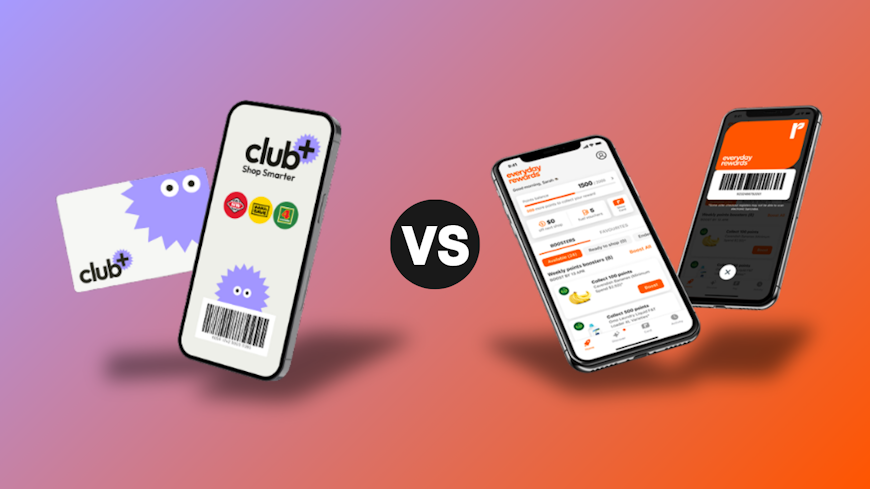
Foodstuffs, which operates Pak’nSave, New World and Four Square, is launching a new loyalty card called Club+. We look at how to sign up and its benefits compared to Woolworths’ Everyday Rewards card.
Nearly 9 out of 10 people use a loyalty card at the supermarket, according to Consumer NZ’s latest supermarket survey.
Most people are using the cards to get the best price they can. It’s hardly surprising we’re reaching for loyalty discounts to combat high prices – in our Sentiment Tracker, 70% of respondents told us the cost of living was their top financial concern, beating out housing and healthcare.
What’s changing with the New World Clubcard?
The New World Clubcard is being replaced by Club+, which can be used across New World, Pak’nSave and Four Square stores.
Up until now, Four Square and Pak’nSave haven’t had a nationwide loyalty programme. Pak’nSave South Island stores had Sticky Club, where shoppers could collect points for fuel discounts. Sticky Club will be replaced by Club+.
Much like the existing New World Clubcard, Club+ will give members access to member-only deals and other promotions and allow them to collect points they can redeem later.
There’s one catch, though – you can’t collect points by shopping at Pak’nSave. However, you can redeem Club+ dollars at all three outlets.
You’ll get 0.75 cents in Club+ dollars for every $1 you spend at New World (the same as the old Clubcard rate) and 0.38 cents for every $1 at Four Square. Certain products, such as tobacco, Lotto tickets and phone top-ups, are excluded.
With the current New World Clubcard fuel promotion, members could get an 8c/L fuel discount at Z and Caltex without making a grocery purchase. With Club+, a $1 minimum grocery spend is required to get a discount.
While there will be a fuel discount attached to Club+, it’s not yet clear what that discount will be. It won’t be announced until the Club+ programme starts on 15 June.
North Island shoppers who don’t want a Club+ card will still be able to get a fuel discount on the receipt.
In the South Island, New World and Pak’nSave customers who don’t have or want a Club+ card will still receive a printed fuel discount receipt, except at the handful of South Island stores who haven’t issued receipts for fuel discounts for some time because they operate their own petrol station. It’s unclear whether non-Club+ members will get a discount from those stores.
Regardless of the fuel discount on offer, we’d advise people to shop around for fuel. Smaller providers and unstaffed stations may offer a cheaper price.
Given climbing petrol prices, loyalty may not pay.
Do I need to switch my existing Clubcard?
Yes. To join Club+, you need to go to clubplus.co.nz or call 0800 80 70 70. Club+ launches on 15 June, and there’s a 6-week transition period before Clubcard finishes altogether.
You can choose a digital or plastic Club+ card. The balance of your New World Clubcard will transfer to the new card on 15 June, or later if you join after that date.
How does Club+ compare with Everyday Rewards?
Although Club+ uses “Dollars” and Everyday Rewards uses points, the actual value of the rewards is exactly the same – 0.75%. In other words, for every $1 you spend at New World, Woolworths or FreshChoice, you’ll get 0.75 cents back (or 0.38 cents for Four Square).
The main difference is that you can redeem Club+ Dollars as soon as you earn them, whereas with Everyday Rewards points, you have to accumulate 2,000 before getting a $15 voucher.
Are loyalty discounts really a good deal?
We did a spot check on loyalty card vs non-loyalty card prices using data collected by Auckland University for the week of 16 February 2026. We compared the supermarket chains at stores in the Wellington region to see whether loyalty paid.
Of the 14 products we looked at, four products were loyalty deals at New World. Yet only two of those deals were cheaper than the same product at Pak’nSave.
Just two products were loyalty deals at Woolworths. One of those products was still cheaper at Pak’nSave, where there is currently no loyalty programme.
However, if you wanted to continue shopping at New World and didn’t have the loyalty card, you’d be missing out on savings.
Purex toilet paper (6-pack) would cost you 33.4% more without the loyalty card, and you’d be paying nearly 29% more for a tin of Wattie’s baked beans.
Whether the loyalty deals are better with the new Club+ card remains to be seen.
Our advice is to shop around, because loyalty may not get you the best price. You can compare deals before heading to the shops via price comparison tools.
Why can’t I earn points at Pak’nSave?
One drawback with the Club+ programme is that you can’t accumulate “Dollars” when you shop at Pak’nSave.
A spokesperson for the supermarket said, “Pak’nSave’s approach has always been focused on delivering low prices for all customers every day, rather than a traditional points-based rewards programme.”
Customers can still get value from the programme via fuel discounts and Club+ picks, which recommend products to you that are on special, and you can accumulate points at New World and Four Square and then redeem them at Pak’nSave, the spokesperson said.
We’re concerned Pak’nSave shoppers will miss out on collecting points. You have to sign up to Club+ to shop online at Pak’nSave, and you can scan the loyalty card instore, so we think you should be able to accumulate the rewards there too.
Instead, there are more rewards available for shopping at New World and Four Square stores, which are generally more expensive.
Why do I have to sign up to shop online?
We’re concerned you now have to sign up to a loyalty programme to shop online at New Zealand’s major supermarkets.
It means the only way to avoid signing up to a supermarket loyalty programme is by shopping instore.
Online shopping, in particular click and collect, is growing in popularity because it’s convenient. Price is also a major driver for where people choose where to shop, according to the Commerce Commission’s 2025 Annual Grocery Report.
Supermarkets already gather data from grocery shops online, so why make people sign up to a loyalty card, too?
Both Foodstuffs and Woolworths told us it’s so online and in person shops are integrated and customers have a single log-on and access to all specials and promotions. They told us the loyalty programmes don’t collect any more of your personal information than what’s already collected when you create an online account.
However, we think it will likely give the supermarket more granular data of every shop you do (instore and online) from which to build customer profiles.
While some shoppers may find this useful, it may also encourage people to buy items they weren’t intending to. It may also sway shoppers to be product focused, in order to gain points and take advantage of specials, rather than focused on price – meaning you could end up spending more, just to get the points.
How do supermarkets use my data?
Both Woolworths and Foodstuffs reassured us that data was being collected in accordance with privacy obligations.
At both supermarket chains, your data can also be disclosed to other businesses that offer goods or services that the supermarket thinks you may be interested in. It also tracks how you use the websites and apps, to enable the supermarkets to target advertising to you.
In such a highly concentrated supermarket sector, we question whether exchanging your data for a deal is a real choice for consumers. To get the deals, we need the cards. Loyalty is becoming a necessity rather than a choice.
In a more competitive market, loyalty would likely work to the shoppers’ benefit. However, in a highly concentrated market, the winner appears to be supermarkets, which are benefiting from collecting our data.
With both supermarket chains now making it mandatory to have a loyalty card to shop online, their data picture of our shopping habits will grow. Understanding shopper dynamics, trends and personal preferences means the supermarkets can create customer strategies that drive sales and understand how far people can be pushed before a price point is untenable.
About our data
The grocery data used for this research article were obtained from the University of Auckland Transdisciplinary Real Cost of Food Database.