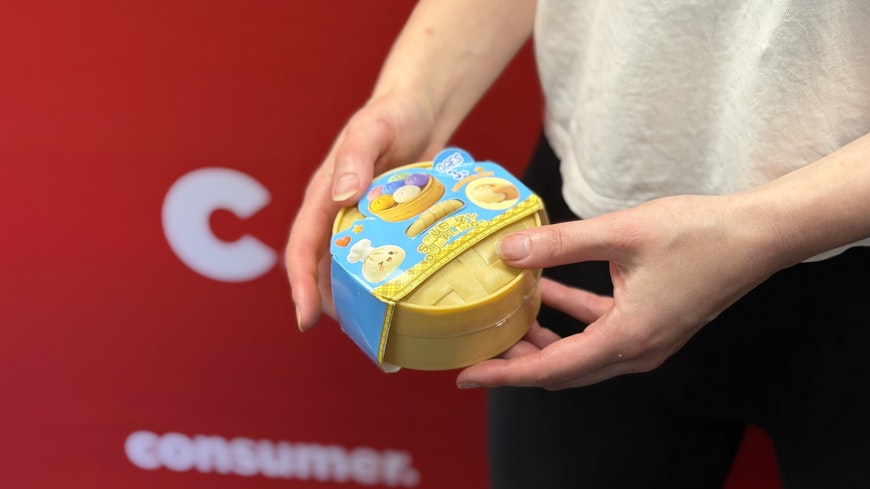
An imitation version of the popular “Squishy Dumpling” toy was recalled in the UK when it was found to have benzene in the outer layer – yet Consumer NZ easily ordered it in New Zealand via the AliExpress website.
How we ordered the recalled toy
A number of “Squeezy Dumplings” were recalled in the UK in June after the benzene was discovered in tests. Benzene can irritate the skin and, where exposure is significant, cause a burning feeling throughout the digestive tract.
The recalled toy is an imitation of the popular “Squishy Dumpling”, originally made by UK company RMS. While several similar toys are available in New Zealand, including at The Warehouse and Kmart, we did not find the recalled version in those stores.
However, we successfully ordered what we believe to be a banned “Squeezy Dumplings” toy from AliExpress in July, after the UK product safety recall.
Head of Research and Advocacy Gemma Rasmussen says the availability of potentially dangerous toys through online marketplaces exposes a fundamental weakness in how product safety is managed in New Zealand.
“Shoppers shouldn’t have to wonder whether a toy is safe. Yet for many products sold online, there has been no independent testing before they reach New Zealand homes. Our product safety laws have not been significantly updated in decades, while our in-store and online marketplaces have changed dramatically.
“We have strong concerns that the toy we ordered contains benzene, but we do not know for sure because chemical testing is prohibitively expensive.”
Why are dangerous toys still available?
Shoppers may assume there is a level of independent testing before products wind up on shelves or in online baskets, but the reality is that manufacturers themselves are often allowed to decide whether products comply with safety requirements.
New Zealand has a product safety standard for children’s toys enforced by the Commerce Commission, which does take action periodically. But the system is far from watertight, and there remains a risk that unsafe products cross our borders every day.
“That system only works if manufacturers are doing the right thing and problems are identified quickly,” Rasmussen says. “Unfortunately, that’s not always the case.”
Asbestos in play sand shows worrying pattern
Recent local incidents have raised broader questions about the reliability of supplier safety assurances. Late last year, asbestos was found in children’s play sand sold in New Zealand. Research by Auckland University of Technology has since confirmed that airborne asbestos fibres could be released during normal play.
The safety regime used by New Zealand and Australian regulators is often heavily reliant on risk assessments commissioned by product suppliers, rather than independently verified testing.
“Whether it’s asbestos in play sand or benzene in a toy, these cases demonstrate why we cannot rely solely on manufacturers’ own safety claims. We need our government to introduce a product safety system in Aotearoa that reflects the risks we currently face in our marketplaces,” says Rasmussen.
How to shop safely for squishy toys
Buy from reputable retailers and established brands.
Ask the retailer for evidence or confirmation that the toy has been safety tested.
Check the toy has clear age recommendations and safety instructions.
How to keep children safe during play
Before letting your child play with the toy, inspect it for strong chemical smells, leaking liquid or gel, tears, cracks, weak seams or loose or detachable small parts that could choke a small child.
Do not allow children to chew, bite, puncture or cut open squishy toys.
Never microwave, heat, freeze or alter the toy.
Remove and dispose of any toy that becomes torn or damaged, leaks or develops a strong chemical smell.
Follow the manufacturer’s instructions and age recommendations.
Supervise younger children during play.
Keep damaged toys away from young children and pets.
Source: Ministry of Business, Innovation & Employment.