By Belinda Castles
Researcher | Kairangahau
We’ve received complaints about a monk fruit sweetener containing 1% monk fruit. We investigated and found two products with even less!
Willa emailed us about Whole Earth Monk Fruit Ultimate Sugar Replacement with erythritol. Her gripe is that the product is marketed prominently as “monk fruit” despite containing only 1% of the ingredient – a fact you don’t find out until you read the fine-print ingredients list on the back.
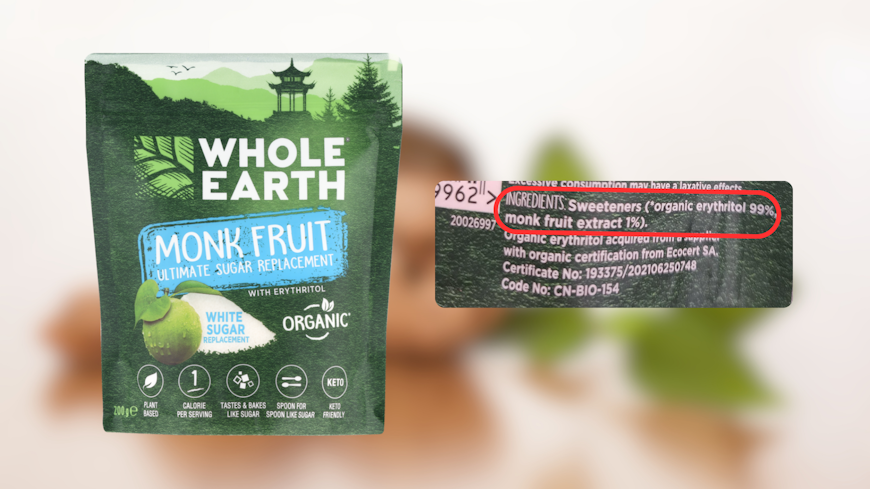
“Looking at the packaging, it would be entirely reasonable for a consumer to assume they are purchasing monk fruit sweetener. It only contains 1% monk fruit extract, which strikes me as blatantly deceptive.”
James also felt ripped off by this product.
“Only 1% monk fruit extract! This is super misleading!”
Robyn was annoyed by the tiny percentage of monk fruit in the product, but also the organic claim on the front label. When she read the back, she realised the organic claim refers to the erythritol, not the monk fruit.
Monk fruit (luo han guo or Siraitia grosvenorii) has gained popularity as a sweetener ingredient and natural sugar alternative for shoppers trying to cut back on sugar or avoid artificial sweeteners. It has 250 to 400 times the sweetness of sugar and has little to no kilojoules. And let’s face it, the name has marketing appeal: “monk fruit” conjures up juicy, natural goodness, while the names of other sugar alternatives sound decidedly more like something from a lab.
Whole Earth isn’t the only brand selling a monk fruit sweetener with minimal monk fruit while prominently displaying the ingredient on the packaging.
Other examples we found:
Lakanto Monk Fruit Sweetener with erythritol contains 1% monk fruit extract.
Natvia Monk Fruit Sweetener with erythritol has 0.6% monk fruit extract.
Truvia Monk Fruit Natural Sweetener with monk fruit and erythritol has 0.3% monk fruit extract.
While all these products state that they contain erythritol on the label, the font is a lot smaller for this ingredient than it is for the monk fruit, despite erythritol being the main ingredient in each case.
Why is there only 1% or less monk fruit in these products?
Monk fruit extract is intensely sweet, which means it can’t be used as a “spoon for spoon” substitute for sugar. For example, if a cake recipe calls for one cup of sugar, you’d need less than a teaspoon of pure monk fruit extract to achieve the same level of sweetness – but without the sugar’s volume and texture, your cake wouldn’t turn out well.
That’s why manufacturers use erythritol to bulk up monk fruit sweeteners. Erythritol is a sugar alcohol that is about 60–80% as sweet as sugar. It is very low in kilojoules and tastes and feels like table sugar, but it can’t be fully digested, so eating too much may have a laxative effect; as such, advisory statements are required on products containing high levels of it. The products we looked at all had this statement.
We couldn’t find any spoon-for-spoon sugar replacement products containing more than 1% monk fruit. So if you’re after a product with only monk fruit extract, you’ll probably need to buy it in liquid or granule form from a health food store (we couldn’t find any in supermarkets).
Liquid 100% monk fruit extract can be added to hot drinks – a few drops should do the trick.
Is the labelling misleading?
The Food Standards Code states that if an ingredient is used in the name of a product, in an on-pack claim or in pictures or graphics, the proportion of that “characterising ingredient” needs to be declared on the pack.
Additionally, the ingredients list must include all ingredients in decreasing order, so the main ingredient will be listed first.
Food labelling must also comply with the Fair Trading Act and not mislead consumers. While the products we looked at did comply with the requirements to state the percentage of ingredients and list the ingredients in descending order, we think there is a risk here that consumers will be misled about the overall composition of the product.
We think these products would be better described as “Erythritol sweetener with monk fruit extract”.

We can't do this without you.
As an independent non-profit, we depend on the generous support of our members and donors to keep us fighting for a better deal.
What did the companies say?
We contacted the companies that make these products about our concerns.
Whole Earth
A spokesperson for New Zealand Sugar Company, the distributor of the Whole Earth sweetener, told us this product has been available in New Zealand since 2020 and that there have been a limited number of complaints during this time.
The company has taken on feedback that some consumers are confused and developed new front-of-pack designs. The name remains the same, but the phrase “with erythritol” has been made more prominent, with a larger font, and positioned alongside “monk fruit”. New packaging is still being worked through the supply chain.
The company spokesperson said the organic claim referred to the erythritol content and wasn’t intended to represent the monk fruit extract as organic.
Lakanto
A spokesperson for the company said, “We believe the current name is accurate, compliant with regulations and reflects the product’s functional identity. Monk fruit in the product name characterises the sweetening system, flavour profile and functional identity of the product. This is consistent with other foods where a low-weight ingredient (for example, vanilla in vanilla yoghurt) is referenced in the product name.”
The spokesperson said the same labelling approach applied to other sugar replacement products with a different characterising sweetener, such as erythritol–stevia blends.
Truvia
A spokesperson for the company said the product packaging met regulation requirements. Ingredients were listed in descending order by weight, and the percentage of monk fruit extract was disclosed.
“We believe these disclosures provide consumers with clear and accurate information about the product’s composition.”
The company that distributes Natvia did not respond.
Have you found any other products making ingredient claims, despite only having a tiny amount of a particular ingredient? If so, we’d like to hear from you. Email [email protected]
What other intense sweeteners are in our food supply?
Monk fruit extract is just one of the intense sweeteners (also known as artificial or natural intense sweeteners) in our food supply. There are 11 others approved for use. These sweeteners are lower in energy than sugar, so they provide a choice for people wanting to reduce their sugar and energy intake.
Intense sweeteners are only allowed to be added to food in an amount that would fully or partly replace the sweetness normally provided by sugar, or to enhance flavour.
If you want to know what sweetener is in a product, check the ingredients list. Under “sweetener” you’ll find the name or food-additive code number. For example, “aspartame” or “951”. Sometimes both the name and number will be listed.
Intense sweeteners have been dogged by controversy over the years. Most of the debate has focused on whether they can cause cancer – aspartame, in particular, hit the spotlight for this reason.

In 2017, Food Standards Australia New Zealand and the Ministry for Primary Industries began a review of the intense sweeteners permitted by the Food Standards Code. It included dietary exposure assessments for different ages. The review collected additional evidence for stevia (steviol glycosides), which was found to be the most frequently used sweetener in foods in both Australia and New Zealand. No public health and safety issues were identified as a result of the review.
Most intense sweeteners have an acceptable daily intake (ADI), which is set by government health bodies. An ADI is the daily amount you could safely eat based on your body weight. ADIs have safety margins and are calculated on lifetime exposure.
In 2023, the International Agency for Research on Cancer and the Joint Expert Committee on Food Additives concluded that although aspartame was a possible carcinogen, the current ADI was accurate. An adult weighing 70kg would need to consume 9–14 cans of a diet soft drinking containing 200 or 300mg of aspartame every day to exceed the ADI, assuming no other intake from other food sources.
Acesulphame potassium (acesulphame-K)
Additive code number: 950
Sweetness: 200 times sweeter than sugar
ADI: 15mg/kg of body weight
Advantame
Additive code number: 969
Sweetness: 20,000 times sweeter than sugar
ADI: 5mg/kg of body weight
Alitame
Additive code number: 956
Sweetness: 2,000 times sweeter than sugar
ADI: 1mg/kg of body weight
Aspartame
Additive code number: 951
Sweetness: 200 times sweeter than sugar
ADI: 40mg/kg of body weight
Aspartame shouldn’t be consumed by people with the rare inherited disorder phenylketonuria (PKU), which is screened for at birth. People with PKU can’t break down phenylalanine, a component of aspartame. For this reason, products containing aspartame must carry a warning label.
Aspartame-acesulphame salt
Additive code number: 962
Sweetness: 350 times sweeter than sugar
ADI: 40mg/kg of body weight for aspartame, 15mg/kg of body weight for acesulphame-K
People with PKU should avoid this sweetener because it contains aspartame.
Cyclamate
Additive code number: 952
Sweetness: 30–50 times sweeter than sugar
ADI: 11mg/kg of body weight
Monk fruit extract
Additive code number: Not applicable
Sweetness: 250–400 times sweeter than sugar
ADI: None, because it has a good safety profile
Neotame
Additive code number: 961
Sweetness: 7,000–13,000 times sweeter than sugar
ADI: 2mg/kg of body weight
Saccharin
Additive code number: 954
Sweetness: 300 times sweeter than sugar
ADI: 5mg/kg of body weight
Sucralose
Additive code number: 955
Sweetness: 600 times sweeter than sugar
ADI: 15mg/kg of body weight
Steviol glycosides (Stevia)
Additive code number: 960
Sweetness: 200 times sweeter than sugar
ADI: 4mg/kg of body weight
Thaumatin
Additive code number: 957
Sweetness: 2,000–3,000 times sweeter than sugar
ADI: None, because it has a good safety profile
Other sweeteners
Sugar alcohols include erythritol, isomalt, mannitol, sorbitol and xylitol. They are generally less sweet than sugar and usually perform another function in a food, including emulsifying or thickening. They can’t be fully digested, so eating too much may have a laxative effect.